

A business exit readiness assessment is a structured evaluation that measures how prepared your company is for a sale, examining financial health, operational independence, governance, and market position to identify gaps that could reduce your valuation or derail a deal. Think of it as a pre-sale diagnostic, not a commitment to sell. The assessment gives you a clear picture of where your business stands today and what needs to change before you go to market. For mid-market owners, this process is the difference between a premium exit and a discounted one.
What is a business exit readiness assessment and what does it cover?

A business exit readiness assessment is a comprehensive review of the factors that drive buyer confidence and deal value. It is distinct from a business valuation, which tells you what your company is worth right now. The assessment tells you why it is worth that amount and, more usefully, what you can do to increase it. Exit readiness assessments reveal hidden value leakage and give owners a roadmap to fix problems before going to market.
The assessment covers five core areas:
- Financial health. Buyers require financials that are Quality of Earnings ready, meaning your statements are normalized to show true, sustainable profitability. One-time expenses, owner perks, and non-recurring revenue must be separated from core earnings. Weak financial reporting is one of the fastest ways to lose buyer confidence.
- Operations. Operational processes are evaluated for efficiency, scalability, and staff dependencies that could pose risks during a sale. A business that runs on the owner’s personal relationships or tribal knowledge scores poorly here.
- Governance and leadership. Buyers want to see management depth, a functioning leadership team, and a clear succession plan. If the business cannot operate without you for 90 days, that is a red flag. Exit scorecards assess founder dependency as a direct readiness factor.
- Market position. Customer concentration, revenue durability, and competitive positioning all factor in. A business where one client represents more than 35% of revenue carries significant risk in buyer evaluations.
- Legal and documentation readiness. Contracts, intellectual property, tax records, and compliance documents must be organized and current. A complete data room prevents last-minute scrambles that erode buyer trust.
Pro Tip: Run a mock due diligence review on your own business before engaging any buyer. Ask your CFO or an outside advisor to request the same documents a buyer would. The gaps you find are exactly what the assessment is designed to surface.
How does an exit readiness assessment affect your valuation and sale?
Poor readiness does not just slow a deal. It costs you money. Failing to address readiness areas like financial reporting and operational independence can cause 20–40% valuation discounts or outright deal failure during due diligence. That range represents real dollars. On a $10 million business, a 30% discount means you leave $3 million on the table.
“Founders often underestimate the buyer’s perspective. Buyers view concentrated customer revenue as a liability that needs mitigation prior to sale.” — CT Acquisitions
Buyers focus on risk-return profiles. They are not just buying your revenue. They are buying the confidence that the revenue will continue after you leave. When your business shows high customer concentration, founder dependency, or unclear financials, buyers either walk away or renegotiate the price downward after their due diligence team finishes. This is called a re-trade, and it is far more common than most owners expect.
Early readiness work changes the dynamic entirely. When your financials are clean, your operations are documented, and your leadership team can run the business independently, buyers compete for your company rather than discount it. The exit planning process becomes a controlled event rather than a reactive scramble. Deals close faster, with fewer surprises, and at prices that reflect the true quality of the business.
A well-prepared data room with organized legal, tax, and IP documents is critical to maintaining buyer confidence and preventing deal renegotiations during due diligence. Cleaning up documentation after a buyer makes an offer is too late. The buyer’s attorneys will find the gaps, and you will pay for them in price reductions or deal delays.
When and how should you conduct an exit readiness assessment?
Timing is the most underestimated factor in exit planning. Industry experts recommend starting an exit readiness assessment 3–5 years before your target exit date to maximize value and avoid rushed decisions. That timeline gives you enough runway to fix what the assessment uncovers.
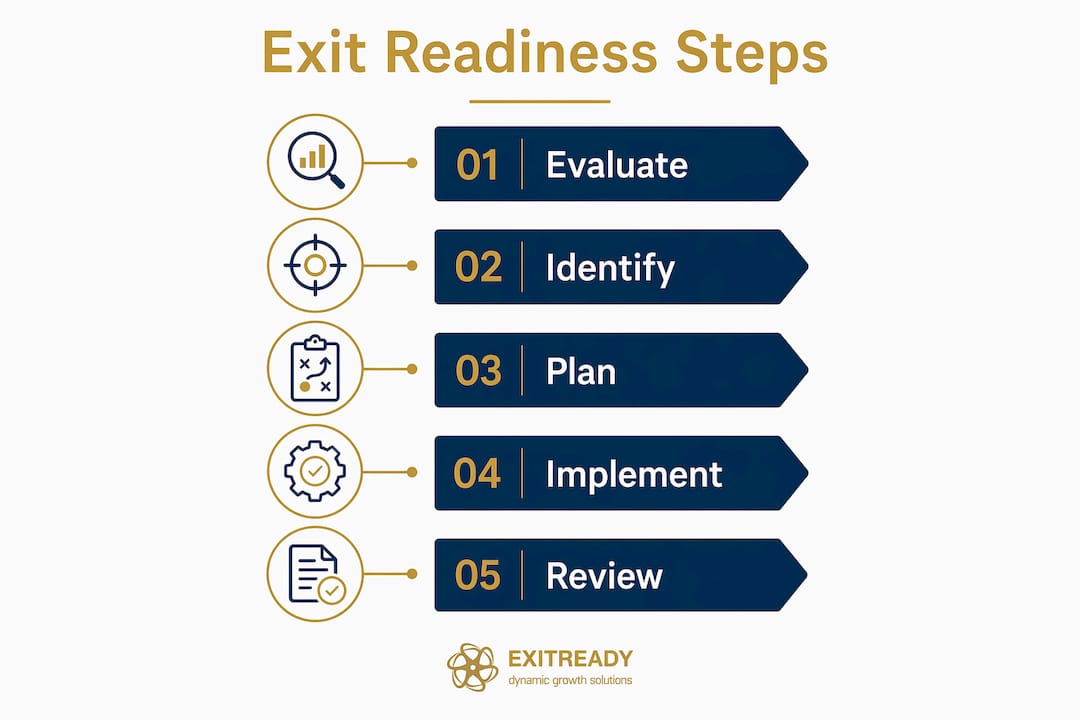
Here is a practical sequence for mid-market owners:
- Conduct an initial assessment 4–5 years out. Use this baseline to identify your biggest gaps across financial, operational, governance, and market dimensions. Prioritize the issues that carry the highest valuation risk.
- Build an improvement plan with measurable milestones. Each gap should have an owner, a deadline, and a clear success metric. Vague intentions do not close valuation gaps.
- Reassess annually. Markets shift, leadership teams change, and customer relationships evolve. An annual review keeps your readiness score current and your plan relevant.
- Engage independent advisors for objectivity. Internal teams are too close to the business to evaluate it the way a buyer will. M&A advisors, fractional CFOs, and exit planning specialists bring the outside perspective that catches blind spots.
- Integrate findings into your exit strategy timeline. Readiness work should connect directly to your broader exit plan, including your target buyer type, deal structure preferences, and post-sale goals.
Pro Tip: Do not wait for a triggering event like a health scare, a partnership dispute, or an unsolicited offer to start your readiness work. Owners who begin the process proactively always have more options and better outcomes than those who start under pressure.
Common pitfalls include starting too late, treating the assessment as a one-time event, and delegating the process entirely to advisors without owner involvement. The assessment requires your direct input because many of the gaps it surfaces are decisions only you can make.
How does an exit readiness assessment compare to other exit planning tools?
Mid-market owners frequently confuse three distinct tools: the business valuation, the exit readiness assessment, and the exit strategy evaluation. Each serves a different purpose at a different stage of the exit journey.
| Tool | Primary focus | Key output | Best used when |
|---|---|---|---|
| Business valuation | Current market worth | Dollar value estimate | Establishing a price baseline |
| Exit readiness assessment | Gaps and improvement areas | Prioritized action plan | 3–5 years before exit |
| Exit strategy evaluation | Buyer type and deal structure | Strategic options | 1–2 years before exit |
A valuation versus readiness scan comparison shows the key difference clearly. A valuation answers “what is my business worth today?” A readiness assessment answers “what is preventing my business from being worth more?” The exit strategy evaluation then answers “how and to whom should I sell?”
These tools work in sequence, not in isolation. Owners who skip the readiness assessment and move straight to exit strategy often discover mid-process that their business has structural problems that kill deals or compress prices. The assessment is the diagnostic layer that makes everything else more effective. For owners exploring exit strategy options, understanding your readiness score first gives you a realistic view of which paths are actually available to you.
Key Takeaways
A business exit readiness assessment is the most effective tool mid-market owners have to identify value gaps, reduce deal risk, and maximize sale price before going to market.
| Point | Details |
|---|---|
| Start 3–5 years early | Beginning the assessment well before your target exit date gives you time to fix gaps that affect valuation. |
| Financial clarity is non-negotiable | Normalized, Quality of Earnings financials are required for premium deal pricing and buyer confidence. |
| Operational independence matters | Businesses that run without the owner command higher prices and attract more buyers. |
| Customer concentration is a deal risk | Revenue concentrated above 35% in one client is a documented red flag for buyers and valuation. |
| Assessment differs from valuation | A valuation shows current worth; an assessment shows what is holding that worth back and how to improve it. |
Why I tell every owner to do this before they think they need to
Most owners I work with come to exit planning too late. Not because they are careless. Because they assume the assessment is something you do when you have decided to sell. That assumption costs them years of preparation time and, in many cases, millions in deal value.
The owners who get the best exits are the ones who treated readiness as an ongoing operating discipline, not a pre-sale checklist. They knew their customer concentration numbers. They had documented processes that did not depend on any single person. Their financials told a clean, consistent story. When a buyer showed up, they were ready to move fast and negotiate from strength.
Exit readiness assessments empower owners to plan exits on their own terms rather than react to circumstances. That is the real value. Not the report itself, but the control it gives you over your own timeline. I have seen owners use assessment findings to make operational changes that added significant value before they ever spoke to a buyer. The assessment did not push them toward selling. It gave them the information to decide when and how to sell, on their schedule.
The uncomfortable truth is that most mid-market businesses are not exit-ready today. That is not a criticism. It is an opportunity. The gap between where your business is and where it needs to be is exactly the value you can capture before you go to market.
— Andre
How Dynamicgrowthsolutions prepares your business for a premium exit

Dynamicgrowthsolutions works with mid-market owners to build the operational foundation that buyers pay a premium for. The AOS (Accelerated Operating System) replaces owner dependency with documented processes, leadership depth, and financial clarity — the exact factors that drive exit readiness scores. Owners who work through the AOS program come out with businesses that run independently, report cleanly, and attract serious buyers. If you want to understand where your business stands today and what it would take to reach a premium exit, the business management systems built by Dynamicgrowthsolutions give you a clear, structured path forward. You can also explore exit-ready business systems to see what operational readiness looks like in practice.
FAQ
What is the difference between an exit readiness assessment and a valuation?
A valuation tells you what your business is worth today. An exit readiness assessment identifies the gaps preventing your business from being worth more, and provides a plan to close those gaps before going to market.
How long does it take to complete an exit readiness assessment?
The assessment itself typically takes a few weeks, depending on business complexity and documentation quality. Addressing the findings takes significantly longer, which is why experts recommend starting 3–5 years before your target exit date.
What are the biggest red flags an exit readiness assessment uncovers?
The most common issues are founder dependency, poor financial normalization, high customer concentration above 35% from one client, and incomplete legal documentation. Each of these can cause valuation discounts of 20–40% or deal failure.
Do I need to be planning to sell soon to benefit from an assessment?
No. An exit readiness assessment is most valuable when conducted years before a planned sale. Owners who complete it early gain time to fix problems and build value, regardless of when they ultimately decide to exit.
What is business succession planning and how does it relate to exit readiness?
Business succession planning defines who will lead the company after the owner exits. Exit readiness assessments evaluate whether that succession plan is credible and whether the leadership depth exists to execute it, making the two processes directly connected.