

Business burnout is defined as a state of chronic cognitive and emotional exhaustion that directly impairs an owner’s ability to make sound decisions, lead effectively, and sustain business performance. Unlike general workplace stress, burnout for business owners is not a personal wellness failing. It is a structural business problem, as authors like Mike Michalowicz and researchers at Tech Founder Coach have documented extensively. Understanding what business burnout means for owners is the first step toward addressing it at the root, not just managing its symptoms.
What does business burnout mean for owners?
Business burnout is the point where an owner’s mental capacity is so depleted that the business itself begins to suffer. The World Health Organization classifies burnout as an occupational phenomenon, not a medical condition, but for owners, the consequences are deeply operational. Decisions slow down. Opportunities get missed. The business stalls because the person running it has nothing left to give.
The critical distinction is that owner burnout compounds differently than employee burnout. Owners carry the weight of every unresolved problem, every unmade decision, and every team member who needs direction. That mental load does not clock out at 5 p.m. It follows owners home, into weekends, and into sleep.

What are the key symptoms and stages of business burnout?
Business burnout symptoms progress in recognizable stages, and catching them early makes the difference between a course correction and a crisis.
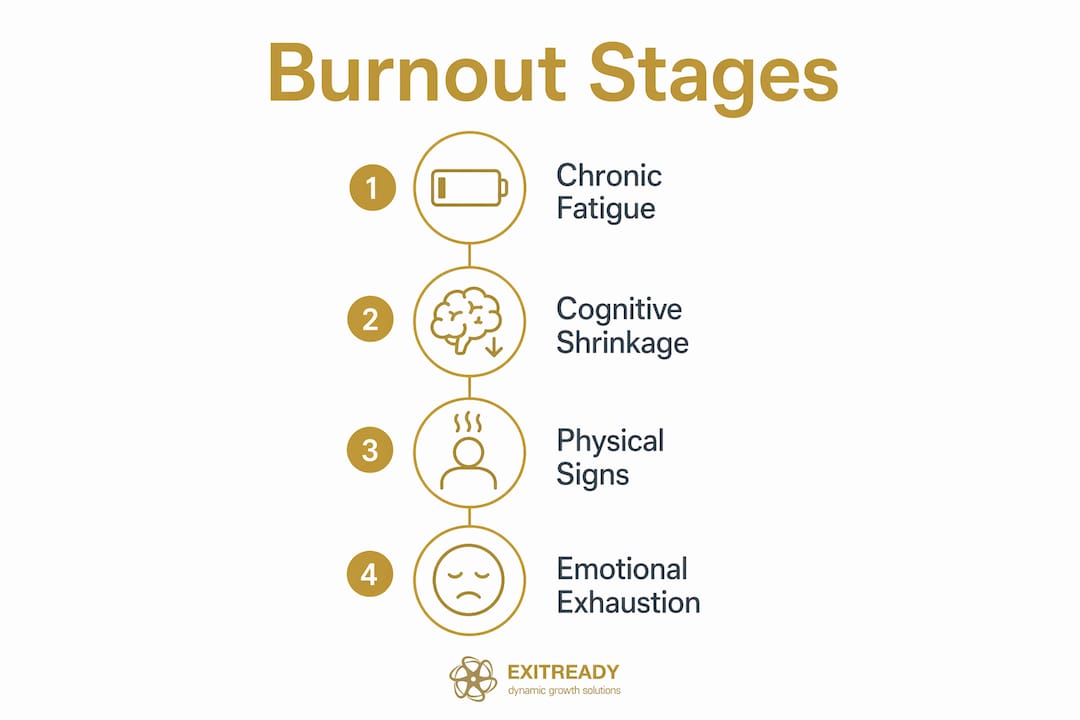
Stage 1: Chronic fatigue that rest does not fix. Owners report sleeping 7 or 8 hours and waking up exhausted. This happens because chronic sympathetic activation prevents the nervous system from fully recovering, even during sleep. The body stays in a low-grade alert state, burning energy without restoration.
Stage 2: Cognitive shrinkage. Burnout reduces the peak productive window to just 2–3 hours per day before reactive, low-value work takes over. For owners who need sharp judgment across pricing, hiring, and strategy, losing 6 or 7 hours of quality thinking time is catastrophic.
Stage 3: Emotional detachment. Owners stop caring about outcomes they once found motivating. They go through the motions. Meetings feel pointless. Customers feel like interruptions. This is not laziness. It is the brain protecting itself from further depletion.
Stage 4: Erosion of self-trust. Burnout symptoms progress from fatigue to a deep loss of confidence in one’s own judgment. Owners second-guess decisions they would have made quickly a year earlier. This hesitation creates bottlenecks across the entire organization.
“The most dangerous stage of burnout is not exhaustion. It is when you stop trusting yourself to lead.”
Physical signs also appear: disrupted sleep, irritability, increased alcohol consumption, and withdrawal from relationships. These behavioral changes are often the first signals that family members and close colleagues notice, even before the owner does.
How does burnout affect owner decision-making and business performance?
Burned-out owners make worse decisions, avoid key tasks, degrade company culture, and lose valuable staff. These are not soft outcomes. They are measurable business risks that show up in revenue, retention, and valuation.
The effects of burnout on owners extend well beyond personal health. Strategic thinking requires mental bandwidth that burnout eliminates. Pattern recognition, the ability to spot a market shift or a team problem before it escalates, degrades first. Creativity follows. What remains is reactive management: putting out fires, approving routine requests, and surviving the day.
| Business Function | Impact of Owner Burnout |
|---|---|
| Decision quality | Slower, more risk-averse, and frequently reversed |
| Hiring and pricing | Strategic mistakes increase over a 3–6 month decline |
| Team culture | Disengagement spreads from owner to staff |
| Staff retention | Key employees leave when leadership feels absent |
| Business valuation | Owner dependency reduces sale price and buyer confidence |
Procrastination is another underappreciated effect. Burned-out owners defer the decisions that matter most, often because those decisions require the most cognitive energy. The business runs on autopilot, which works until it does not.
Pro Tip: Track how many hours per day you spend on decisions only you can make. If that number is above four, your business has a structural dependency problem, not just a workload problem.
Is business burnout a personal failure or a structural problem?
Burnout is a structural problem driven by the owner’s constant mental availability, not a failure of personal endurance or self-care. This reframe matters enormously. Owners who see burnout as a personal weakness try to fix it with vacations, meditation apps, and better morning routines. Those tools help at the margins. They do not fix the underlying architecture.
The uncomfortable truth is that business success without operational independence makes burnout worse. A growing business with no documented systems and no distributed decision authority means more complexity lands on the owner’s desk every month. The business gets bigger. The owner gets more trapped.
| Common Burnout Response | Why It Falls Short |
|---|---|
| Taking a vacation | Mental load resumes the moment you return |
| Delegating tasks informally | Without documented processes, delegation fails repeatedly |
| Setting personal boundaries | Without business infrastructure, mental boundaries are unenforceable |
| Hiring more staff | New staff without clear systems adds management burden |
Successful founders often become the single point of failure in their own companies. Every question routes to them. Every exception requires their approval. Every crisis needs their presence. This structure accelerates burnout because the owner cannot truly disengage, even when they want to.
Pro Tip: Ask yourself: “If I took two weeks completely offline, what would break?” Every honest answer is a documented system you have not built yet.
What practical strategies can owners use to prevent burnout?
Preventing owner burnout requires structural changes to the business, not just changes to personal habits. The strategies below address root causes rather than symptoms.
-
Document every repeating decision. Write down the criteria for decisions your team asks you about more than once. A written decision framework lets others act without escalating to you. This is the foundation of operational independence.
-
Build a business operating system. A business operating system defines how your company runs without relying on your daily presence. It includes documented workflows, role clarity, and performance metrics that any competent manager can follow.
-
Create a clear exit plan. Building a clear exit plan provides psychological relief by giving owners mental freedom and transforming how they relate to operational stress. Knowing the business can function without you shifts your mindset from trapped to in control. Dynamicgrowthsolutions offers exit planning resources specifically designed to reduce this psychological burden.
-
Establish protected thinking time. Block 90 minutes each morning for high-value work before checking messages. Burned-out owners who reclaim their 2–3 hour peak window report faster recovery than those who try to rest their way back to productivity.
-
Engage peer support. Peer connection reduces isolation and normalizes owner struggles, breaking mental barriers even when structural business issues persist. CEO peer groups, mastermind events, and advisory boards all serve this function. The act of naming the problem in a room of people who understand it is itself restorative.
-
Use diagnostic tools to identify your biggest operational drains. Before you can fix what is breaking you, you need to know what it is. A structured business analysis, like the 360-ProfitDriver assessment, surfaces hidden inefficiencies that quietly multiply owner workload.
Standard self-care advice fails without documented operational systems and distributed decision authority. Owners who combine personal recovery practices with structural business changes recover faster and stay recovered longer.
Key Takeaways
Business burnout for owners is a structural business problem that requires operational solutions, not just personal recovery strategies.
| Point | Details |
|---|---|
| Burnout is structural | Owner dependency on daily decisions creates the mental load that causes burnout. |
| Cognitive shrinkage is measurable | Peak productive capacity drops to 2–3 hours per day under sustained burnout. |
| Business performance suffers | Decision quality, staff retention, and business valuation all decline with owner burnout. |
| Self-care alone is insufficient | Without documented systems and distributed authority, personal recovery strategies fail. |
| Exit planning provides relief | A clear exit plan shifts owner mindset and reduces the psychological weight of daily operations. |
What I have learned watching owners hit the wall
The owners I have worked with who burned out hardest were almost always the most capable ones. They built real businesses. They had real customers, real revenue, and real teams. And then they became the ceiling their own company could not grow past.
The pattern repeats: a founder builds something that works, and because it works, everything routes through them. The business grows. The owner’s calendar fills. Sleep degrades. Decisions slow. The business that was supposed to create freedom becomes a second job with no HR department and no one to complain to.
What I have found is that the mindset shift matters as much as the operational fix. Owners who accept that burnout is a systems failure, not a character flaw, move faster. They stop defending the way things have always worked and start asking what needs to be documented, delegated, or eliminated. That question alone changes the trajectory.
The owners who struggle longest are the ones who keep trying to outwork the problem. They add hours, cut sleep, and push through. Burnout does not respond to effort. It responds to architecture. Build the right structure and the pressure lifts. Keep pushing without changing the structure and the wall gets closer, not further away.
— Andre
How Dynamicgrowthsolutions helps owners move past burnout
Burnout does not resolve itself. It resolves when the business stops depending entirely on the owner’s presence to function.

Dynamicgrowthsolutions works with mid-market owners to build the operational infrastructure that makes that independence real. The AOS (Accelerated Operating System) replaces owner dependency with documented playbooks, distributed authority, and measurable performance systems. For owners who are ready to stop being the bottleneck, the EXITREADY events offer peer connection, expert guidance, and a clear path forward. Whether your goal is a premium exit or simply a business that runs without you in every room, the starting point is the same: build the system before the system breaks you.
FAQ
What does business burnout mean for a business owner?
Business burnout means a chronic state of cognitive and emotional exhaustion that impairs an owner’s decision-making, leadership, and business outcomes. It differs from stress because rest alone does not restore function without structural changes to how the business operates.
What are the earliest signs of burnout in entrepreneurs?
The earliest signs of burnout in entrepreneurs include fatigue that sleep does not fix, shrinking daily productivity, and growing irritability or emotional detachment. Procrastination on high-stakes decisions is another early warning that owners frequently overlook.
How does burnout affect a business’s value?
Owner fatigue reduces a business’s sale price because buyers discount companies where operations depend entirely on one person. A business that cannot function without its owner is structurally fragile, and that fragility shows up directly in valuation.
Can a vacation fix business owner burnout?
A vacation provides temporary relief but does not fix burnout when the underlying business structure remains unchanged. Without documented systems and distributed decision authority, the mental load returns the moment the owner re-engages.
How long does it take to recover from business burnout?
Recovery time varies, but founders who combine personal recovery practices with structural business changes, such as documented workflows and delegated decisions, recover faster than those who rely on rest alone. The structural fix is what prevents relapse.