

A premium exit is defined as a business sale that achieves top-quartile valuation multiples through documented operational independence, clean financials, and a buyer-ready leadership structure. Most mid-market owners treat exit planning as a transaction. The ones who capture maximum value treat it as a multi-year transformation. Only 20%–30% of businesses that go to market actually close a sale, largely because of undocumented processes and owner dependency. To prepare business for a premium exit, you need to start earlier than feels necessary, build deeper than feels required, and document more than feels comfortable.
How to prepare your business for a premium exit
The industry term for this process is exit readiness, and it covers financial, operational, and personal dimensions simultaneously. Owners who treat these as separate workstreams consistently underperform at the negotiating table. The goal is to build a business that operates, grows, and generates predictable cash flow without you in the room. That single quality is what separates a 5x EBITDA offer from a 7x one.
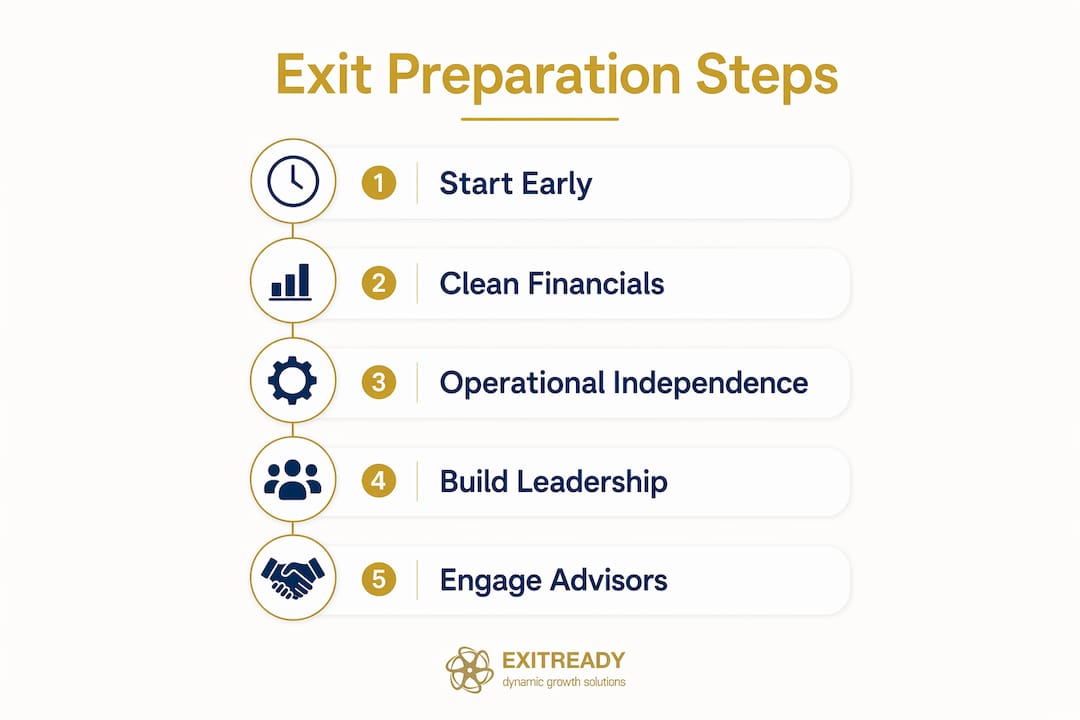
Owners starting 24–36 months before sale consistently capture top-quartile multiples. Those who rush to market in under six months typically leave 15%–30% of enterprise value behind. The math is unambiguous: preparation is not a cost, it is a return on investment.
Three pillars drive premium valuation in every mid-market deal: financial transparency, operational independence, and personal goal alignment. Each section below addresses one of these in depth, with a timeline and advisory framework to tie them together.

How does financial cleanup increase your business sale price?
Clean financials are the single most controllable lever you have before going to market. Buyers do not pay for potential. Buyers pay for predictable cash flow backed by clear growth plans and documented financials. Vague projections and cash-basis books signal risk, and risk compresses multiples.
The first move is shifting to accrual accounting. Cash-basis financials are rarely accepted for valuation by serious buyers. Produce reviewed or audited financial statements at least 12–18 months before your target sale date. That timeline gives buyers a full operating year of clean data to underwrite, and it gives you time to correct anomalies before they become deal issues.
Add-backs require equal discipline. Owners routinely overestimate personal expenses that can be added back to EBITDA. Buyers discount add-backs by 12%–18% during due diligence unless each one is supported by documentation and reasonable assumptions. An unsupported $200,000 add-back does not add $200,000 to your valuation. It triggers skepticism about everything else in your financials.
Key financial preparation steps before going to market:
- Convert to accrual accounting and reconcile at least two full years of statements
- Document every add-back with receipts, contracts, or third-party evidence
- Normalize owner compensation to market rate for your role
- Eliminate personal expenses run through the business
- Prepare a clear EBITDA bridge that shows adjustments from reported to normalized earnings
Pro Tip: Run a mock due diligence exercise 6–9 months before your planned sale. Hire an outside advisor to identify deal-killers proactively before a buyer’s team does. Issues found early can be fixed. Issues found late collapse deals or crater valuations.
The role of clean financials in exit outcomes cannot be overstated. Every dollar of normalized EBITDA you document accurately multiplies by your deal multiple. At a 6x multiple, one additional $100,000 of defensible EBITDA is worth $600,000 at closing.
What operational changes reduce owner dependency and boost buyer appeal?
Operational independence is the quality buyers pay the highest premiums for. Being sell-ready means buyers are confident the business can operate without the founder’s daily involvement post-sale. If you are the primary rainmaker, the key account manager, and the final decision-maker on everything, buyers see a liability, not an asset.
Building a second-tier management team is the highest-ROI operational investment you can make. A documented management structure and SOPs reduce perceived owner risk and directly increase sale price. Buyers underwrite the team as much as the financials.
Here is a practical sequence for building operational independence over 12–18 months:
- Identify every function that currently depends on you personally. Map your weekly activities and categorize each as owner-critical or delegable.
- Hire or develop a second-tier leadership layer. A VP of Operations, a sales director, or a CFO-level finance lead signals to buyers that the business runs on systems, not on you.
- Document standard operating procedures for every core process. Client onboarding, project delivery, financial reporting, and HR processes all need written playbooks.
- Reduce customer concentration. No single client should represent more than 15%–20% of revenue. Buyers apply concentration discounts aggressively above that threshold.
- Lock in contracts. Multi-year agreements with key clients and vendors reduce revenue risk and increase the predictability buyers pay for.
Pro Tip: Transition key account relationships and sales responsibilities to your leadership team at least 12 months before going to market. Buyers will test this during management presentations. If every client relationship still runs through you, the deal will reflect that dependency in price or structure.
How to align your personal wealth and lifestyle goals with your exit strategy
Less than 25% of owners achieve full personal-business-financial alignment before a sale. That gap costs them in two ways: they choose the wrong exit path for their situation, and they face unexpected tax consequences that reduce net proceeds significantly.
The main exit paths available to mid-market owners each carry different implications:
- Strategic sale to a corporate buyer or private equity group: highest headline price, typically requires full exit or earnout
- Management buyout (MBO): preserves legacy, often lower headline price, structured over time
- Employee Stock Ownership Plan (ESOP): significant tax advantages, complex to structure, works best for profitable companies with stable workforces
- Family transfer: lowest tax efficiency without proper estate planning, high emotional complexity
- Recapitalization: sell a majority stake to private equity while retaining equity for a second bite
“Personal wealth goals and exit strategies must integrate to optimize legacy, tax outcomes, and future lifestyle.” — Bank of America Business Resources
Tax planning is not a closing-day activity. Structuring the deal as an asset sale versus a stock sale, using installment sales, or establishing a Qualified Opportunity Zone investment can each save millions in federal and state taxes. Engage a tax attorney and a CPA with M&A experience at least 18–24 months before your target close. Davis Wright Tremaine and similar M&A-focused law firms emphasize that estate and tax strategy decisions made before a letter of intent is signed are far more powerful than those made after.
Explore the full range of exit strategy options before committing to a path. The right structure depends on your age, tax situation, post-sale involvement preferences, and legacy goals.
What steps should you take over 12–18 months to maximize business valuation?
The 12–18 month window before going to market is where premium exits are built or lost. Owners who invest this time in structured preparation often realize a valuation increase of 44% compared to those who rush to market in under six months. A business generating $1.5M in EBITDA at a 5x multiple is worth $7.5M. With focused preparation that supports a 6x multiple, the same business is worth $10.8M. That $3.3M difference is the direct return on preparation.
Here is a month-by-month framework for the 12–18 month preparation window:
- Months 1–3: Complete a full financial audit. Convert to accrual accounting. Identify and document all add-backs. Benchmark your EBITDA margin against industry peers.
- Months 3–6: Build your second-tier management team. Assign key account ownership to non-owner leaders. Begin SOP documentation for all core processes.
- Months 6–9: Run a mock due diligence exercise. Address every issue uncovered. Lock in multi-year client contracts. Reduce customer concentration below 20% per client.
- Months 9–12: Finalize reviewed or audited financial statements. Develop a documented growth narrative with realistic, costed projections. Prepare a management presentation.
- Months 12–18: Engage investment bankers or M&A advisors. Begin controlled outreach to strategic and financial buyers. Manage the process with full data room readiness.
| Preparation action | Valuation impact |
|---|---|
| Shift to accrual accounting with audited statements | Removes buyer discount for financial risk; supports higher multiple |
| Document and support all add-backs | Prevents 12%–18% discount on normalized EBITDA |
| Build second-tier management team | Reduces owner-dependency discount; increases buyer confidence |
| Reduce customer concentration below 20% | Eliminates concentration discount applied by most PE buyers |
| Lock multi-year client contracts | Increases revenue predictability; supports higher multiple |
| Develop documented growth narrative | Shifts buyer focus from risk to opportunity |
Pro Tip: Do not engage advisors before your preparation is largely complete. Advisors retained too early run processes before the business is ready, which damages credibility with buyers and weakens your negotiating position.
How do you build the right advisory team for a high-value exit?
The right advisory team does not replace your preparation. It amplifies it. Each advisor plays a distinct role, and the sequence in which you engage them matters as much as who you choose.
Core advisory roles for a mid-market exit:
- Investment banker or M&A advisor: Manages the sale process, creates competitive tension among buyers, and negotiates deal structure. Engage after preparation is complete.
- M&A attorney: Handles letter of intent review, purchase agreement negotiation, and rep and warranty issues. Firms like Davis Wright Tremaine specialize in founder and family business transactions.
- Tax advisor or CPA: Structures the deal for maximum after-tax proceeds. Must be engaged 18–24 months before close for full impact.
- Quality of Earnings (QoE) provider: Produces an independent financial analysis that validates your EBITDA and add-backs before buyers run their own diligence. A clean QoE report accelerates deals and reduces late-stage retrading.
| Advisor role | When to engage | Primary value |
|---|---|---|
| Tax advisor or CPA | 18–24 months before close | Maximize after-tax proceeds |
| M&A attorney | 12–18 months before close | Protect deal terms and structure |
| QoE provider | 6–9 months before close | Validate financials and reduce buyer risk |
| Investment banker | After preparation is complete | Run competitive process and maximize price |
Business operating systems, like the AOS framework offered by Dynamicgrowthsolutions, provide the operational infrastructure that advisors need to see. Documented processes, financial dashboards, and leadership accountability structures all signal to buyers that the business is built to run without its founder. The role of advisors in exit transactions is to execute a well-prepared process, not to compensate for a business that is not ready.
Key takeaways
A premium exit requires financial transparency, operational independence, and personal goal alignment built over 12–18 months before going to market.
| Point | Details |
|---|---|
| Start 12–18 months early | Owners who prepare over this window realize up to 44% higher valuations than those who rush. |
| Clean financials multiply value | Every documented dollar of EBITDA is worth your full deal multiple at closing. |
| Build operational independence | A second-tier management team and documented SOPs are the top drivers of buyer confidence. |
| Align personal and business goals | Less than 25% of owners achieve this alignment; those who do choose better exit paths and pay less tax. |
| Engage advisors at the right time | Retain investment bankers and M&A counsel after preparation is complete, not before. |
What I’ve learned watching owners leave money on the table
The most common mistake I see is not financial. It is psychological. Owners spend years building a business around their own judgment, relationships, and presence. Then they expect a buyer to pay a premium for something that cannot function without them. That is not a business. That is a job with overhead.
The second most common mistake is treating tax planning as a closing-day task. By the time a letter of intent is signed, most of the high-value tax strategies are off the table. The owners who walk away with the most are the ones who engaged a qualified CPA and M&A attorney two years before they needed them.
I have also seen owners destroy deals by inflating add-backs without documentation. A buyer’s diligence team will find every unsupported adjustment. When they do, the conversation shifts from valuation to credibility. You do not recover from that.
The owners who achieve genuine premium exits share one trait: they build a transferable business, not just a profitable one. Transferability means documented systems, a capable team, diversified revenue, and financials that tell a clear, honest story. That combination is what exit planning that maximizes value actually looks like in practice.
Start earlier than you think you need to. The preparation window is where the premium is built.
— Andre
How Dynamicgrowthsolutions helps you exit at maximum value
Mid-market owners who want to prepare business for a premium exit need more than advice. They need a system. Dynamicgrowthsolutions built the AOS (Accelerated Operating System) specifically to replace owner dependency with documented processes, leadership accountability, and financial discipline that buyers pay top dollar for.
The AOS framework covers everything from SOP documentation and management team development to financial reporting and growth narrative preparation. Dynamicgrowthsolutions also provides access to a network of buyers, advisors, and fractional executives who support the full exit process. If you are ready to build a business that commands a premium, start with the business operating system that makes it possible. You can also use the business scalability checklist to identify your highest-priority preparation gaps today.
FAQ
What does “prepare business for a premium exit” actually mean?
It means building operational independence, clean financials, and a capable leadership team so buyers pay top-quartile multiples. The process typically takes 12–18 months of focused preparation before going to market.
How early should I start preparing for a business sale?
Start 24–36 months before your target sale date for the best outcome. Owners who begin this early consistently capture top-quartile multiples, while those who rush in under six months leave 15%–30% of enterprise value behind.
What is a Quality of Earnings report and do I need one?
A Quality of Earnings (QoE) report is an independent financial analysis that validates your EBITDA and add-backs before buyers run their own diligence. It accelerates deals, reduces late-stage retrading, and signals financial credibility to serious buyers.
Why do buyers discount add-backs during due diligence?
Buyers discount unsupported add-backs by 12%–18% because optimistic adjustments without documentation signal financial risk. Every add-back must be supported by receipts, contracts, or third-party evidence to hold its full value in negotiations.
What is the biggest operational factor buyers evaluate?
Buyers evaluate whether the business can operate without the founder. A second-tier management team, documented SOPs, and diversified client revenue are the top signals that a business is genuinely transferable and worth a premium price.