

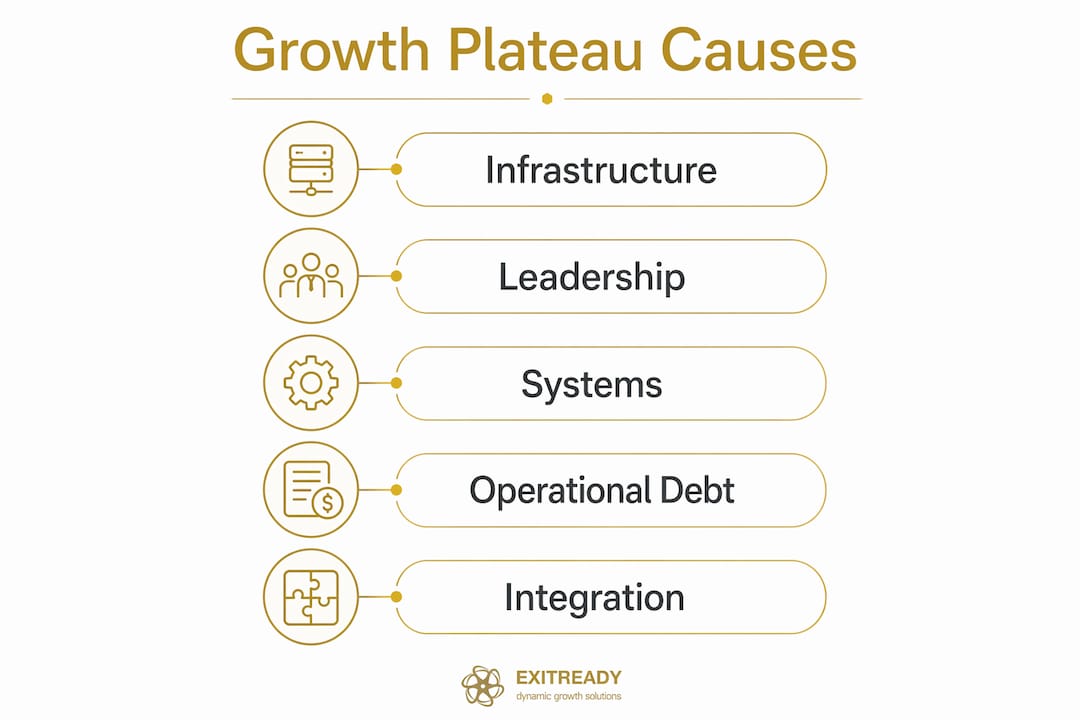
Mid-market businesses plateau when their operating infrastructure fails to evolve alongside increasing scale and complexity. This is not an execution problem. It is a structural one. Only 18% of private mid-market SaaS companies maintain a Rule of 40 score as of Q2 2026, down from 35% in 2021. That collapse reflects what happens when growth rate and EBITDA margin cannot coexist inside an operating model built for an earlier stage. The causes behind this stagnation are consistent: operational debt, leadership bottlenecks, and margin erosion driven by systems that were never designed to scale.
What structural factors cause mid-market businesses to plateau?
Leaders frequently misattribute growth stalls to poor execution. The real cause is infrastructure that cannot support growth. Adding headcount or increasing marketing spend delivers poor returns when the underlying systems cannot process the additional volume. This is the core reason why mid-market stagnation is so persistent and so expensive.
42% of B2B SaaS companies plateau between $15M and $25M ARR due to headcount-linked growth compressing margins, rising customer acquisition costs, and fragmented operations absorbing up to 40% of total capacity. That absorbed capacity is not visible on a P&L, but it shows up in missed deals, delayed onboarding, and founder exhaustion.
Several structural forces converge to create this pattern:
- Headcount-linked growth: Revenue scales with people, not systems. Margins compress as payroll grows faster than revenue.
- Rising customer acquisition costs: Buyer committee expansion in B2B markets means more stakeholders per deal, longer sales cycles, and higher cost per close.
- Operational fragmentation: Sales, marketing, and onboarding run on disconnected tools with manual handoffs. Those handoffs create delays and accountability gaps that compound over time.
- Market saturation dynamics: As addressable markets mature, the law of large numbers makes each incremental growth percentage harder to achieve.
“Infrastructure is the architecture of enterprise value. Capital markets emphasize structural integrity over go-to-market strategy.” — Grey Strategic Architecture
Operational debt is the hidden accumulator behind all of these forces. It includes fragmented reporting, inconsistent onboarding, and brittle system integrations. Left unaddressed, it causes missed revenue, founder burnout, and leadership turnover as complexity increases.
How do leadership bottlenecks stall growth?

Founder-centric operations create bottlenecks as organizational complexity grows. At 40 or more employees, informal coordination no longer scales. Context that once traveled through hallway conversations and founder intuition disappears. Formal processes become critical, and most mid-market firms have not built them.
The problem compounds when leadership teams hold conflicting assumptions about direction and success metrics. Misaligned leadership on growth direction creates structural friction that slows execution velocity across every department. A VP of Sales optimizing for new logos while the COO optimizes for margin is not a personality conflict. It is a systems failure.
Three leadership patterns consistently stall mid-market growth:
- Concentrated decision authority: The founder or CEO approves too many decisions. Execution slows because nothing moves without their input.
- Undocumented processes: Tribal knowledge replaces written playbooks. When key people leave, institutional knowledge walks out with them.
- Unclear role ownership: Teams duplicate work or leave gaps because accountability is assumed rather than defined.
Pro Tip: Map every recurring decision in your business to a specific role. If more than 30% of those decisions route back to the founder, you have a bottleneck that no amount of hiring will fix.
Distributed decision-making requires documented processes and clear decision rights. Without both, leadership alignment is a conversation that happens once a quarter and dissolves within weeks. The common bottlenecks in business growth that stall mid-market firms almost always trace back to this concentration of authority at the top.
Why do mid-market firms struggle with systems integration?
Mid-market firms occupy an uncomfortable position in the software market. They are too large for basic SaaS but too small for enterprise-grade platforms that require dedicated IT teams and multi-year implementation budgets. This is the mid-market software trap, and it creates operational friction that compounds with every new tool added to the stack.
The consequences are predictable. Brittle integrations break under volume. Reporting becomes inconsistent because data lives in five systems that do not talk to each other. Onboarding varies by rep because there is no single source of truth. Each of these failures erodes customer experience and internal execution simultaneously.
| Approach | Short-Term Cost | Long-Term Risk |
|---|---|---|
| Basic SaaS stack | Low | Breaks under scale; manual workarounds multiply |
| Enterprise ERP forced fit | Very high | Poor adoption; implementation drag for 2–3 years |
| Tailored integrated architecture | Moderate | Lower operational risk; scales with the business |
Forcing enterprise solutions onto mid-market operations is costly and less effective than building tailored infrastructure over a 2–3 year horizon. The firms that scale past the plateau invest in scalable business infrastructure before the pain becomes acute, not after it becomes a crisis.
Pro Tip: Before adding any new software tool, ask one question: does this integrate with your existing data layer, or does it create another reporting silo? If the answer is the latter, the tool will cost more in coordination than it saves in efficiency.
Mid-market companies with integrated systems maintain higher and more sustainable growth rates as annual recurring revenue compounds. The integration is not incidental. It is the mechanism that allows growth to continue without proportional headcount increases.
What strategies help mid-market companies break the plateau?
Breaking a growth plateau requires more than effort. It requires a different operating model. Growth bets are more about transforming business models than incremental effort. The firms that successfully scale past $25M ARR share a common pattern: they shift from founder-driven growth to repeatable, institutionalized revenue engines before the plateau forces them to.
Here are the five strategies that consistently work:
- Install process infrastructure before pressure mounts. Companies that scale successfully invest in process infrastructure before it is perfect. Waiting until systems break means fixing them under pressure, which damages culture and execution simultaneously.
- Shift to a repeatable revenue engine. Move from heroic, owner-driven sales to documented, institutionalized processes. This means defined lead stages, written qualification criteria, and onboarding playbooks that do not depend on any single person.
- Align leadership on vision, roles, and success metrics. Conduct a structured alignment session at least twice per year. Define what winning looks like for each function, and make sure those definitions do not conflict at the organizational level.
- Integrate your core operating systems. Sales, marketing, onboarding, and operations should share a single data layer. Disconnected tools create the manual handoffs that absorb 40% of operational capacity in stalled mid-market firms.
- Simplify before you scale. Complexity often grows faster than revenue. Audit your product lines, customer segments, and internal workflows annually. Eliminate what does not contribute to core margin.
Pro Tip: The best time to build your operating infrastructure is when growth feels easy. The worst time is when it feels urgent. Treat process discipline as a proactive investment, not a reactive fix.
Learning how to scale a mid-market business systematically means accepting that the operating model that got you to $15M will not get you to $50M. That transition requires deliberate architectural choices, not more of the same activity.
Key takeaways
Mid-market businesses plateau because their operating infrastructure, leadership structure, and systems cannot support the complexity that comes with scale.
| Point | Details |
|---|---|
| Structural cause, not execution | Plateaus stem from infrastructure failure, not effort deficits — adding headcount without systems delivers poor returns. |
| Leadership concentration stalls growth | When decision authority concentrates at the founder level, execution slows across every department. |
| The software trap is real | Mid-market firms need tailored integrated systems, not basic SaaS or forced enterprise platforms. |
| Proactive infrastructure wins | Installing process infrastructure before pressure mounts costs less and preserves culture versus reactive overhauls. |
| Repeatable revenue beats heroic sales | Shifting to institutionalized revenue engines is the defining move that separates firms that scale from those that stall. |
The uncomfortable truth about mid-market plateaus
I have worked with enough mid-market owners to know that the plateau almost always surprises them. Revenue was growing. The team was energized. Then, somewhere between $10M and $30M, the math stopped working. More effort produced less result. That surprise is itself a data point.
The founders who recover fastest are the ones who stop looking for the execution failure and start looking at the architecture. They ask: what does our operating model actually require from us to grow another 30%? The answer is almost never “more sales calls.” It is almost always “a different system.”
The cultural shift is harder than the technical one. Moving away from hero-driven growth means telling your best people that their individual brilliance is no longer the primary asset. The system is. That conversation is uncomfortable. It is also the only one that produces lasting results.
I have also seen the retrospective fix destroy companies that could have survived. A firm that waits until operational debt becomes a crisis will spend 18 months rebuilding systems while competitors move. The cost is not just financial. It is cultural. People leave when chaos becomes the operating norm.
The mid-market demands a higher complexity management effort than either small business or enterprise stages, precisely because the middle layer of management that absorbs complexity in large firms does not yet exist. You are building that layer while running the business. That is the real challenge, and no amount of motivation solves it. Only architecture does.
— Andre
How Dynamicgrowthsolutions helps you move past the plateau
If the structural causes behind your growth stall sound familiar, the next step is not another strategy session. It is an operating system built for your stage.

Dynamicgrowthsolutions works with mid-market owners to install the AOS (Accelerated Operating System), a proprietary framework that replaces owner dependency with documented processes, integrated systems, and distributed leadership. The result is a business that grows without requiring the founder in every decision. Explore what a business operating system actually looks like for a mid-market owner, or review systematized business processes that have helped firms at your stage move past the plateau and toward a premium exit or long-term scale.
FAQ
Why do mid-market businesses plateau more than small businesses?
Mid-market firms carry more operational complexity than small businesses but lack the management layers that large enterprises use to absorb it. This gap makes informal coordination break down faster and structural failures more costly.
What is the rule of 40 and why does it matter for mid-market growth?
The Rule of 40 measures a company’s health by adding its revenue growth rate and EBITDA margin. Only 18% of private mid-market SaaS companies maintained a Rule of 40 score as of Q2 2026, reflecting how difficult it is to balance growth and profitability at scale.
How does founder dependency cause a business plateau?
When decision authority concentrates at the founder level, execution slows because nothing moves without their approval. At 40 or more employees, informal coordination breaks down and formal processes become critical to sustaining growth velocity.
What is operational debt in a mid-market context?
Operational debt is the accumulated cost of undocumented processes, fragmented systems, and inconsistent execution. It causes missed revenue, founder burnout, and leadership turnover as organizational complexity increases.
How long does it take to overcome a mid-market growth plateau?
The timeline depends on how deeply operational debt has accumulated. Firms that install integrated operating infrastructure proactively typically see results within 12–18 months. Retrospective overhauls under pressure take longer and carry higher cultural risk.