

Clean financials are organized, reconciled, and accurately documented financial statements that directly determine how much your business sells for and whether the deal closes at all. The role of clean financials in exit is not a soft advantage. A business generating $500,000 in EBITDA can command a 5x multiple instead of 3x when its books are defensible, adding $1 million in exit proceeds before a single negotiation begins. Buyers, private equity firms, and strategic acquirers all use financial quality as the primary lens for pricing risk. Clean financial statements reduce that perceived risk and protect your final number.
How clean financials impact valuation multiples at exit
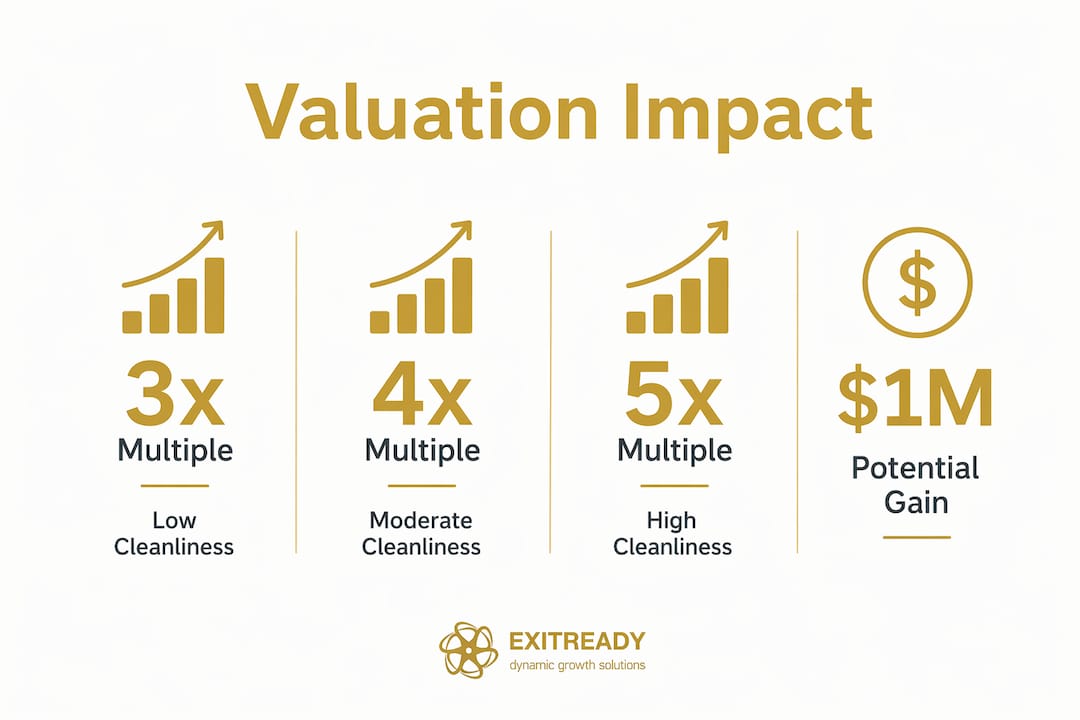
Valuation multiples are not fixed. Buyers adjust them up or down based on the quality and reliability of your financial records. A business with inconsistent categorization, unexplained expenses, or missing reconciliations signals operational risk. That risk gets priced into the offer.
The concept of normalized EBITDA sits at the center of every valuation conversation. Normalized EBITDA removes one-time costs, personal expenses, and non-recurring items to show a buyer the true earning power of the business. When your books make that calculation easy to verify, buyers accept the number. When they cannot verify it, they discount it.

| Financial Cleanliness Level | Typical EBITDA Multiple | Buyer Confidence |
|---|---|---|
| Inconsistent, undocumented records | 2x–3x | Low |
| Partially reconciled, some gaps | 3x–4x | Moderate |
| Clean, reconciled, GAAP-compliant | 4x–5x | High |
| Audited with full documentation | 5x–6x+ | Very High |
The difference between a 3x and a 5x multiple on $500,000 EBITDA is $1 million in your pocket. That gap is not driven by revenue growth or market conditions. It is driven entirely by the quality of your financial records.
Pro Tip: Start normalizing your EBITDA at least two years before your target exit date. Buyers want to see a consistent pattern, not a single clean year.
What do buyers expect during due diligence?
Buyers do not skim your financials. They reconstruct them. The Quality of Earnings (QoE) report, commissioned by most serious acquirers, is an intense audit that rebuilds EBITDA from the ground up using your source documents, bank statements, and accounting records. This is not a cursory review. It is a line-by-line examination designed to find every gap, inconsistency, and unexplained entry.
When buyers find problems during a QoE audit, they do not walk away quietly. They use those findings as leverage to reduce the price, extend timelines, or increase escrow holdbacks. Clean financial statements remove that leverage before the conversation starts.
Common buyer expectations and red flags during due diligence include:
- Consistent accounting methods across all reporting periods, with no unexplained switches between cash and accrual basis
- Documented owner expenses clearly separated from business operating costs, with written justification for any add-backs
- Current balance sheet reconciliations with no stale inventory, uncollectible receivables, or phantom assets
- Source documents for every material transaction, including contracts, invoices, and bank statements
- Clean revenue recognition with no channel stuffing, deferred revenue misclassification, or one-time spikes presented as recurring
Balance sheet accuracy is one of the most overlooked areas. Stale inventory and uncollectible receivables directly reduce working capital, which affects the final purchase price through working capital pegs. The balance sheet often determines the last $100,000 or more of deal proceeds.
Pro Tip: Run a mock QoE on your own books 12 months before going to market. Hire a fractional CFO or accounting firm to stress-test your records the same way a buyer would.
What “clean” actually means vs. what owners assume
Most owners assume clean financials means perfect financials. That assumption causes two problems. First, owners delay cleanup because perfection feels unachievable. Second, they miss the actual standard buyers apply.
Buyers seek defensibility and consistency, not perfection. A clean set of books means every number can be traced to a source document and explained in under a minute. That is the real test. Here are the four practices that create genuinely defensible financials:
- Apply consistent accounting methods. Use the same revenue recognition and expense categorization rules across every reporting period. Switching methods mid-stream without documentation is a red flag that triggers buyer scrutiny.
- Document and recast owner-related expenses. Personal expenses run through the business must be identified, documented, and formally recasted as add-backs. Undocumented owner expenses are the single greatest risk to buyer confidence and valuation.
- Reconcile every account monthly. Accounts receivable, accounts payable, payroll liabilities, and bank accounts must all match your general ledger. Gaps here signal weak financial controls.
- Audit your source documents. Every material transaction needs a corresponding invoice, contract, or bank record. Missing source documents create doubt about the accuracy of your reported numbers.
Overlooked issues that cause deal delays include personal vehicle expenses buried in operating costs, family member salaries above market rate, and inconsistent depreciation schedules. None of these are fatal if documented. All of them become fatal if discovered by a buyer without explanation.
How early should you start cleaning up your financials?
Starting financial cleanup 9–12 months before exit is the minimum recommended lead time. Many owners wait until 90 days before going to market. That is too late to restate financials properly, too late to establish a consistent track record, and too late to fix issues without raising buyer suspicion.
A full bookkeeping cleanup project typically involves reconciling 200–500 transactions per month and can take 3–6 months to restate financials to GAAP standards. That timeline alone justifies starting early. Add the time needed to establish a documented month-end close process with a 10-business-day reconciliation deadline, and 12 months becomes the realistic minimum.
| Cleanup Approach | Timeline | Cost Range | Risk Level |
|---|---|---|---|
| DIY with existing bookkeeper | 6–12 months | Low direct cost | High: gaps likely missed |
| Fractional CFO engagement | 3–6 months | Moderate | Medium: depends on scope |
| Accounting firm restatement | 3–6 months | Higher | Low: GAAP-compliant output |
| Full audit by CPA firm | 6–12 months | Highest | Very Low: buyer-ready |
The DIY approach carries the highest risk because internal bookkeepers often lack the exit-specific knowledge to identify what buyers scrutinize. A fractional CFO or CPA firm with M&A experience brings a buyer’s perspective to your cleanup. That perspective is what turns adequate books into exit-ready financial records.
For owners following a multi-year exit timeline, the financial cleanup phase fits naturally into year two of a three-year plan. That pacing allows for two full years of clean, consistent financials before going to market, which is exactly what buyers want to see.
How clean financials shift negotiation leverage
Negotiation leverage in a business sale is not fixed at the letter of intent stage. It shifts continuously based on what buyers discover during due diligence. Financial uncertainties discovered in due diligence give buyers the tools to push down prices, delay closings, and increase escrow holdbacks. Every gap in your books is a negotiating chip in the buyer’s hand.
“Clean books do not just protect your price. They protect your timeline, your terms, and your ability to walk away from a bad deal.”
Escrow holdbacks are a direct consequence of financial uncertainty. When a buyer cannot verify your working capital or earnings quality, they protect themselves by holding back a portion of the purchase price in escrow, sometimes 10–15% of deal value, pending post-close adjustments. Clean financials reduce the justification for large holdbacks.
Deal fall-throughs during due diligence are frequently caused by financial discrepancies. A deal that collapses after months of negotiation costs you time, money, and often forces a lower valuation in the next attempt because the market now knows you were once under contract. Clean books prevent that outcome entirely.
Pro Tip: Maintain your financial discipline throughout the entire sale process, not just before going to market. Buyers often request updated financials at closing, and a drop in quality between LOI and close gives them grounds to renegotiate.
Key takeaways
Clean financials are the single most controllable factor in maximizing your exit valuation, protecting your negotiation leverage, and closing the deal on your terms.
| Point | Details |
|---|---|
| Valuation multiple impact | Clean books can shift your EBITDA multiple from 3x to 5x, adding millions in exit proceeds. |
| QoE audits are intense | Buyers rebuild EBITDA from source documents and use every gap to justify price reductions. |
| Start 9–12 months early | Restating financials to GAAP standards takes 3–6 months; rushing creates deal-killing errors. |
| Defensibility beats perfection | Every number must be traceable to a source document and explainable in under one minute. |
| Balance sheet accuracy matters | Stale inventory and uncollectible receivables reduce working capital and final deal proceeds. |
The uncomfortable truth about financial cleanup
I have worked with dozens of mid-market owners who believed their financials were “good enough” for a sale. Almost none of them were right. The gap between what an owner considers acceptable and what a buyer considers defensible is wider than most people expect.
The owners who maximize their exit proceeds share one habit. They treat financial cleanup as a multi-year discipline, not a pre-sale sprint. They engage advisors early, not when the deal is already in motion. They understand that working with experienced exit advisors is not an expense. It is the highest-return investment in the entire exit process.
The most common mistake I see is owners who do a surface-level cleanup: they fix the obvious errors, reconcile the last three months, and assume they are ready. Then the QoE audit finds two years of inconsistent expense categorization and a balance sheet with $200,000 in uncollectible receivables. The buyer drops the price by $400,000. The owner is shocked. They should not be.
My advice is direct. Start your financial cleanup today, even if you are three years from exit. Build the monthly close discipline now. Document every owner expense now. Engage a fractional CFO or M&A-experienced CPA now. The cost of doing this early is a fraction of the value it protects at closing.
— Andre
Get your books exit-ready before it costs you
Dynamicgrowthsolutions works with mid-market owners who want to close at the highest possible multiple, not discover financial problems after the letter of intent is signed. The EXITREADY strategic finance program provides the financial infrastructure, monthly close discipline, and expert advisory support that buyers expect to see.

The 360-ProfitDriver analysis uncovers hidden revenue and financial gaps before a buyer does, giving you the time and information to fix them on your terms. Dynamicgrowthsolutions also hosts exclusive CEO mastermind events where financial exit readiness is a core curriculum topic. Reserve your seat at the next EXITREADY event and walk away with a clear financial cleanup plan built for your specific exit timeline.
FAQ
What are clean financials in a business exit?
Clean financials are accurate, reconciled, and fully documented financial statements where every number traces back to a source document. Buyers define clean as defensible and consistent, not necessarily perfect.
How much can clean financials increase my sale price?
A business with $500,000 in EBITDA can command a 5x multiple instead of 3x when its books are clean, adding $1 million in exit proceeds before negotiation begins.
What is a quality of earnings report?
A Quality of Earnings (QoE) report is a buyer-commissioned audit that reconstructs EBITDA from source documents and identifies every inconsistency in your financial records. Buyers use QoE findings to justify price reductions and deal renegotiation.
When should i start cleaning up my financials before exit?
Start at least 9–12 months before going to market. A full GAAP-compliant restatement takes 3–6 months, and you need additional time to establish a consistent financial track record that buyers trust.
What happens if buyers find financial issues during due diligence?
Buyers use financial discrepancies to reduce the purchase price, increase escrow holdbacks, delay closing, or walk away entirely. Financial gaps discovered late in the process are the leading cause of deal fall-throughs.