

A business that runs without its owner is defined by documented systems, delegated authority, and automated workflows that sustain operations regardless of the owner’s daily presence. This concept, formally known as an “owner-independent business” or “self-sustaining company,” is the gold standard for mid-market entrepreneurs who want time freedom, scalable growth, or a premium exit valuation. To build a business that runs without owner involvement, you need four pillars: process documentation, capable leadership, technology automation, and structured testing. This guide covers every step, tool, and timeline required to get there.
What foundational elements does a self-running business require?
The foundation of any business that operates without its owner is a library of Standard Operating Procedures. SOPs written as step-by-step instructions enable anyone unfamiliar with a task to perform it successfully. That means every repeatable function, from onboarding a client to processing payroll, must be written down with enough specificity that a new hire can execute it on day one without asking the owner a single question.
Beyond documentation, you need three additional layers:
- Leadership infrastructure: A general manager or operations director who owns daily decisions. Without this role filled, every escalation lands back on the owner’s desk.
- Technology stack: Workflow automation platforms like Zapier, Make, or n8n handle rule-based task routing, notifications, and data transfers without human intervention. These tools connect your CRM, project management software, and financial systems into a single operating loop.
- Reporting and dashboards: A weekly scorecard or live dashboard gives the owner visibility into key metrics, revenue, fulfillment status, and team performance, without requiring them to attend every meeting or review every file.
| Foundation Layer | Primary Tool or Method | Owner Benefit |
|---|---|---|
| Process documentation | SOPs, Notion, Google Docs | Removes knowledge dependency |
| Leadership | General manager or ops director | Eliminates daily decision escalations |
| Automation | Zapier, Make, n8n | Reduces manual task volume |
| Reporting | KPI dashboards, weekly scorecards | Maintains visibility without micromanagement |
Pro Tip: Before automating anything, document it first. Automating a broken or undocumented process only speeds up the chaos. Write the SOP, test it with a team member, then automate the steps that are repetitive and rule-based.
How to delegate responsibilities and reduce owner dependency
Delegation is the most misunderstood skill in business ownership. Most owners delegate tasks but retain authority, which means the team executes but the owner still decides. True delegation transfers both the task and the decision-making power that goes with it.
Here is a practical sequence for building real delegation:
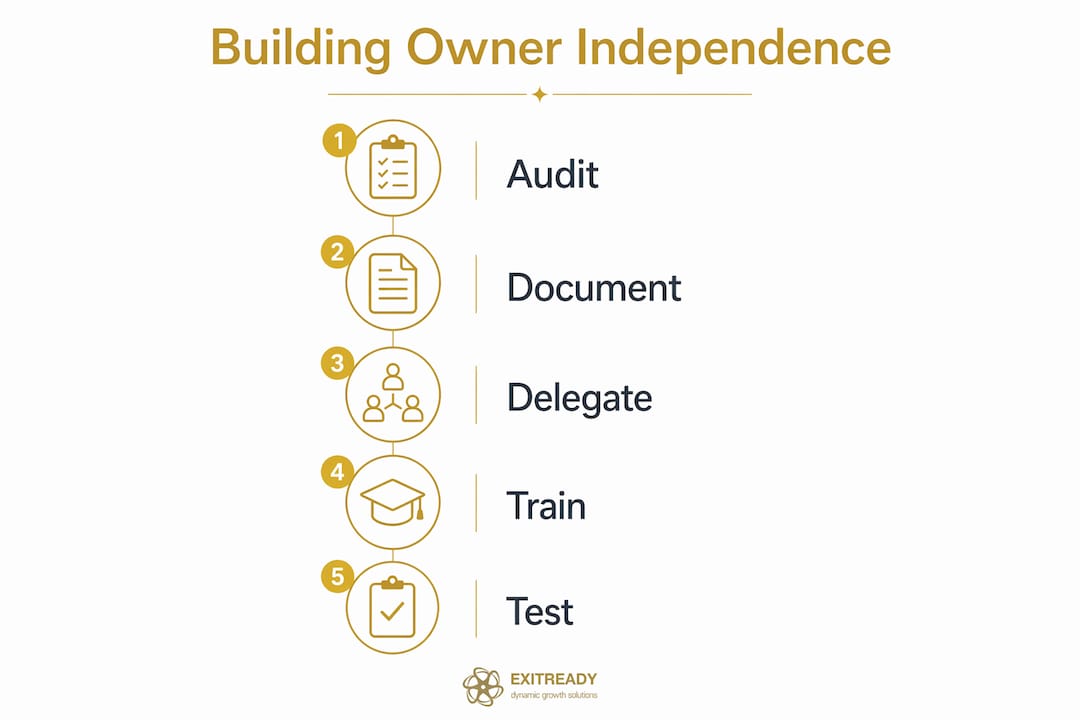
- Audit every owner-dependent task. Spend two weeks logging every decision, approval, and question that reaches you. This list becomes your delegation roadmap.
- Document before you delegate. Delegation fails without training, real authority, and realistic expectations. Write the SOP first, then hand it off with clear boundaries on what the delegate can decide independently.
- Hire or promote a general manager. This person is your operational proxy. They need enough authority to hire, fire, approve spending within defined limits, and resolve client issues without your sign-off.
- Train using your documented systems. Onboarding a manager with your SOPs cuts ramp time significantly and creates accountability because the standard is written, not verbal.
- Shift from approver to reviewer. In the first 90 days, review decisions after the fact rather than approving them in advance. This builds the manager’s confidence and breaks your habit of being the bottleneck.
- Introduce AI for decision support. AI tools can handle customer inquiries, flag anomalies in financial data, and route support tickets without human involvement. This extends your team’s capacity without adding headcount.
Pro Tip: Give your general manager a defined “authority matrix” on day one. List every category of decision, the dollar threshold, and whether they need to inform you, consult you, or act independently. Ambiguity is the enemy of delegation.
Owners who skip the authority matrix find themselves pulled back into operations within weeks, not because their manager is incompetent, but because neither party knows where the boundary sits. Clarity on authority is what separates a vacation-ready business from a genuinely self-sustaining company.

What is the step-by-step process to build owner independence?
Transforming an owner-dependent business into one that operates without daily involvement is a phased process. The realistic transition timeline is 18 to 24 months, and owners who try to compress it into 90 days typically fail because the systems are not tested under real conditions before the owner steps back.
Here is the phased roadmap:
- Phase 1 (Months 1 to 3): Audit and document. Map every owner-dependent task. Prioritize the top 20 by frequency and business impact. Write SOPs for each one. Identify which tasks can be automated immediately using tools like Zapier or Make.
- Phase 2 (Months 4 to 6): Build the leadership layer. Hire or promote a general manager. Begin structured onboarding using your documented systems. Establish weekly reporting cadences so you receive data, not questions.
- Phase 3 (Months 7 to 12): Transfer authority progressively. Move from approver to reviewer across each function. Introduce automation for repetitive workflows. Test the team’s ability to handle escalations without you for short periods, starting with one week.
- Phase 4 (Months 13 to 18): Stress test the system. Conduct a structured two-week absence. Track every breakdown, decision gap, and escalation. Use the results to close documentation gaps and clarify authority boundaries.
- Phase 5 (Months 19 to 24): Optimize and shift to strategic oversight. The owner moves into a chairman role, setting direction and reviewing performance monthly rather than weekly. The business now operates as an automated business model with human management executing within defined systems.
| Phase | Timeline | Primary Milestone |
|---|---|---|
| Audit and document | Months 1 to 3 | Top 20 SOPs written and tested |
| Build leadership layer | Months 4 to 6 | General manager onboarded |
| Transfer authority | Months 7 to 12 | Owner removed from daily approvals |
| Stress test | Months 13 to 18 | Two-week absence completed |
| Strategic oversight | Months 19 to 24 | Owner in chairman role |
A critical insight that most guides miss: a business running at 80% efficiency with systems and trained staff is valued higher by acquirers than one running at 100% efficiency with the owner at the center of every decision. Buyers pay a premium for predictability, not perfection.
Pro Tip: Use a simple “owner hours per week” metric as your freedom score. Track it monthly. If you are working 60 hours in month one and 40 hours in month six, the system is working. If the number is not declining, you have a documentation or authority gap to fix.
How can AI automation accelerate business autonomy in 2026?
Traditional automation handles fixed rules. If a form is submitted, send an email. If a payment is received, update the CRM. These workflows are valuable but limited. They break when conditions fall outside the predefined rules, and they cannot make judgment calls.
Agentic AI workflows employ judgment and coordination, enabling autonomous decision-making that goes well beyond fixed-rule automation. An AI agent can analyze a customer complaint, determine the appropriate resolution based on policy, draft a response, escalate if needed, and log the outcome, all without human involvement. This is a qualitatively different capability from a Zapier workflow.
The business implications are significant:
- 24/7 operations without staffing costs. AI agents do not take vacations, get sick, or require benefits. They handle customer service, lead qualification, and data analysis continuously.
- The AI agents market is growing at 46.3% CAGR, projected to reach $52.62 billion by 2030. This growth signals that the tools are maturing rapidly and becoming accessible to mid-market businesses, not just enterprise players.
- Agent-to-agent commerce. Modern AI payment infrastructures enable microtransactions and agent-to-agent commerce without manual approval, removing traditional billing friction from automated workflows.
- Scalability without headcount. Automation compounds value without management overhead, often outperforming small teams in revenue per operator for lean businesses.
“The founder sets direction. The AI team handles continuous execution.” This is the 2026 model for owner-independent operations, where the owner transitions to a chairman role and the business runs on a combination of trained staff and intelligent automation.
The practical starting point is identifying three to five repetitive, judgment-light tasks in your business and deploying AI agents to handle them. Customer FAQ responses, appointment scheduling, invoice follow-up, and lead scoring are common entry points. Once those are running reliably, you expand the scope.
What challenges should you expect and how do you test true autonomy?
Most owners discover hidden dependencies only when they try to step away. The business appears to run smoothly until a non-routine situation arises, and suddenly every decision routes back to the owner because no one else has the context, authority, or documented process to handle it.
Common obstacles include:
- Undocumented tribal knowledge. Key processes exist only in the owner’s head. Staff can handle routine tasks but freeze on anything outside the script.
- Authority gaps. The team has responsibility but not authority. They know what needs to happen but cannot act without owner approval.
- Owner mindset. Many owners intellectually want independence but emotionally resist it. They insert themselves into decisions out of habit, undermining the systems they built.
- Inadequate reporting. Without a reliable dashboard, owners feel compelled to stay involved because they cannot see what is happening from a distance.
The standard method to verify genuine autonomy is the 14-day removal test. The owner removes themselves completely from operations for two full weeks, no email, no Slack, no approvals. Every breakdown, escalation, and decision gap that surfaces during those two weeks represents a system failure that needs to be fixed. The test is not about achieving perfection. It is about identifying exactly where the gaps are so you can close them systematically.
The difference between a vacation-ready business and a truly autonomous one is this: a vacation-ready business survives two weeks without the owner. A truly autonomous business grows during those two weeks because the systems and team are capable of executing and improving without oversight.
Pro Tip: Before your 14-day test, brief your general manager on three scenarios: a major client complaint, a key employee resignation, and an unexpected cash flow shortfall. If they can walk you through how they would handle each one using your documented systems, you are ready to step away.
Key takeaways
A business that runs without its owner requires documented SOPs, delegated authority with a clear authority matrix, technology automation, and verified autonomy through structured absence testing.
| Point | Details |
|---|---|
| Document before delegating | SOPs must be written and tested before any task is handed off to staff or automation. |
| Hire a general manager early | This role is the single highest-leverage hire for reducing owner dependency. |
| Use the 18 to 24 month timeline | Realistic transitions take time; compressed timelines produce untested systems that fail under pressure. |
| Test with the 14-day removal test | Two weeks of complete absence reveals every hidden dependency and authority gap in the business. |
| AI extends human delegation | Agentic AI handles judgment-based tasks continuously, compounding autonomy without adding headcount. |
Why owner independence is harder than it looks, and worth every bit of the effort
I have worked with enough mid-market owners to know that the hardest part of building a self-sustaining company is not the systems. It is the identity shift. Most owners built their business by being the best operator in the room. Stepping back feels like abandoning the thing that made them successful.
What I have seen consistently is that owners who frame this transition as “giving up control” struggle and stall. Owners who frame it as “building an asset that works for them” move through it faster and with less resistance. The systems are the same. The mindset is different.
The other thing I tell every owner I work with: accept imperfect delegation early. Your general manager will make decisions you would not have made. Some of those decisions will be wrong. That is the cost of building a business that does not depend on you. The alternative is staying trapped in operations indefinitely, which is a far higher cost.
The exit readiness connection is also real and financially significant. Acquirers discount heavily for owner dependency because they are buying a business, not a job. Every hour you remove yourself from daily operations and replace it with a documented system or trained manager increases the multiple a buyer will pay. Owner independence is not just a lifestyle goal. It is a valuation strategy.
The owners who commit to this process fully, document obsessively, delegate with real authority, and test their systems rigorously, end up with something most business owners never achieve: a company that grows whether they show up or not.
— Andre
How Dynamicgrowthsolutions helps you build owner-independent operations
Building a business that operates without you requires more than good intentions. It requires a structured operating system, proven frameworks, and expert guidance to close the gaps between where you are and where you need to be.
Dynamicgrowthsolutions built the AOS (Accelerated Operating System) specifically for mid-market owners who want to replace owner dependency with documented, delegated, and automated systems. Whether your goal is time freedom, scalable growth, or a premium exit, the AOS gives you the architecture to get there. Explore the business operating system for owners to see how the framework maps to your specific situation. For owners focused on long-term growth infrastructure, the sustainable growth management systems program provides the full implementation roadmap.
FAQ
What does it mean to build a business that runs without the owner?
It means creating documented systems, delegated authority, and automated workflows that sustain operations without the owner’s daily involvement. The formal term is an “owner-independent business,” and it is the foundation for both scalable growth and exit readiness.
How long does it take to make a business owner-independent?
The realistic timeline is 18 to 24 months for a typical owner-dependent business. Compressed timelines produce untested systems that fail when non-routine situations arise.
What is the 14-day removal test?
The 14-day removal test requires the owner to step away completely from operations for two weeks, with no approvals, emails, or decisions. Every breakdown that surfaces identifies a documentation gap or authority gap that needs to be resolved.
How does AI fit into business operations without daily involvement?
AI agents handle judgment-based tasks like customer resolution, lead scoring, and data analysis continuously without human oversight. The AI agents market is projected to reach $52.62 billion by 2030, making these tools increasingly accessible for mid-market businesses.
Does an owner-independent business have higher valuation?
A business running at 80% efficiency with trained staff and documented systems is consistently valued higher than one running at 100% efficiency with the owner at the center of every decision. Buyers pay a premium for predictability and transferability, not owner involvement.