

Exit advisors are the process architects who manage every stage of a business sale, from preparation and buyer outreach through due diligence, negotiation, and closing, to maximize price, deal certainty, and favorable terms for the seller. For mid-market business owners, the role of advisors in exit transactions goes far beyond making introductions to buyers. A coordinated advisory team, typically including an investment banker, a transactional attorney, a tax professional, and a CPA, controls the information flow, shapes the valuation narrative, and protects your negotiating position at every turn. Without that coordination, even a well-run business leaves significant value on the table.
How advisors coordinate and control the exit transaction process
A sell-side advisor manages the exit as a controlled execution process, handling preparation, buyer outreach, diligence, offer comparison, and negotiation to improve price and deal terms. That definition matters because most owners underestimate how much process discipline drives final outcomes. The advisor is not just a middleman. The advisor is the architect of a sequence designed to create competitive tension and protect your leverage at every stage.

The process begins well before any buyer sees your business. Advisors build marketing materials, develop a targeted buyer list, and stage disclosures carefully. Confidential Information Memoranda go out only after non-disclosure agreements are signed. Management meetings are scheduled strategically, not reactively. This sequencing prevents buyers from gaining information advantages that could suppress your valuation.
Information flow control is one of the most underappreciated advisor functions. By timing the release of financial data, Q&A responses, and operational details, advisors prevent buyers from identifying gaps or risks that could justify lower bids. The goal is to keep multiple buyers engaged simultaneously, which sustains competitive pressure through the letter of intent stage.
Diligence is where deals most often stall or deteriorate. Advisors organize request lists, enforce data consistency, and coordinate responses across your internal team, legal counsel, and accounting staff to meet buyer deadlines without creating contradictions. A sell-side execution typically spans 9 to 12 months, with diligence alone lasting 4 to 8 weeks. Delays during that window erode buyer confidence and weaken your position.
- Develop and distribute the Confidential Information Memorandum to qualified buyers
- Manage non-disclosure agreement execution before any sensitive data is shared
- Sequence buyer outreach to maintain competitive tension through the LOI stage
- Coordinate diligence responses across legal, financial, and operational workstreams
- Enforce deadlines to prevent deal fatigue and protect negotiation leverage
Pro Tip: Never let buyers conduct diligence in an unstructured way. Your advisor should run a virtual data room with controlled access, version tracking, and a formal Q&A log. This prevents conflicting information from reaching different buyers and keeps your narrative consistent.
What specialized roles do different advisors play in exit transactions?
A typical exit advisory team includes an investment banker, a transaction attorney, a tax professional experienced in M&A, and the owner’s CPA, each playing specialized roles that are essential to the outcome. Understanding who does what prevents gaps in coverage and avoids the costly mistake of relying on one advisor to handle responsibilities outside their expertise.
Investment bankers act as the quarterback of the advisory team, coordinating across roles to keep the process organized, on schedule, and consistent in its narrative across deal stages. They lead buyer outreach, run the competitive bid process, and manage the LOI comparison. Their cross-role coordination is their biggest value, not just their network.
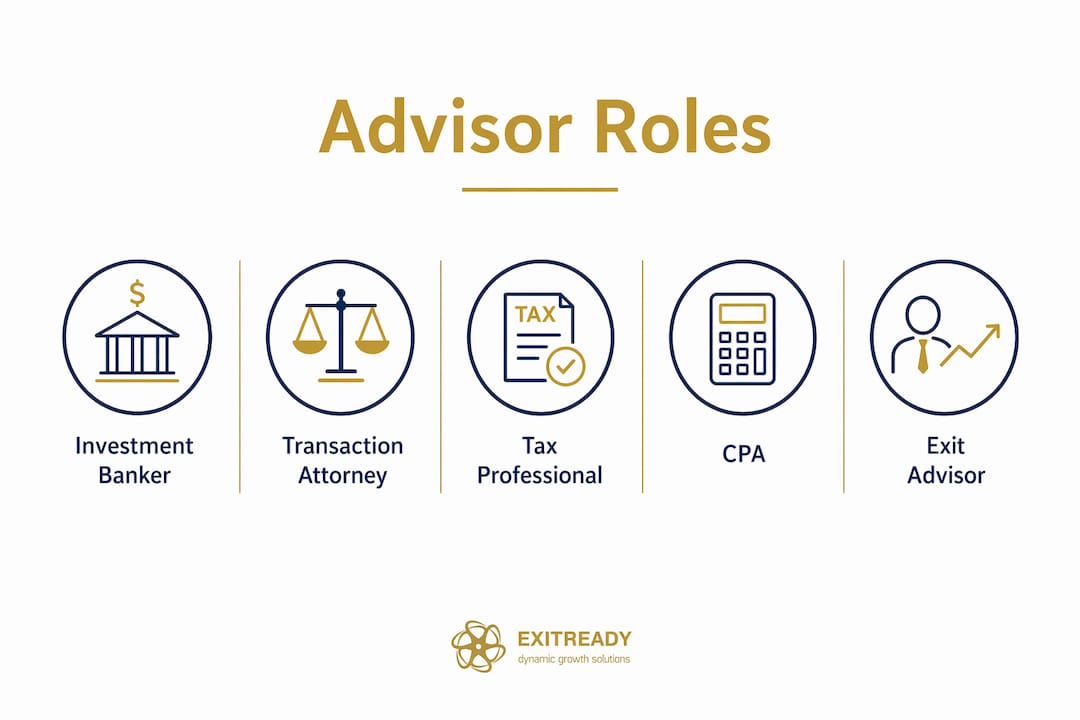
| Advisor role | Primary function | When they engage |
|---|---|---|
| Investment banker | Process leadership, buyer outreach, bid management | Pre-market through closing |
| Transactional attorney | Contract drafting, risk allocation, legal documentation | LOI through closing |
| Tax professional | Deal structure modeling, after-tax proceeds optimization | Pre-LOI through closing |
| CPA | Financial normalization, diligence support, accuracy validation | Pre-market through diligence |
| Internal management | Data preparation, operational continuity, buyer confidence | Diligence through closing |
Tax advisors deserve particular attention because their work often happens before most owners think to involve them. Early involvement of tax advisors modeling deal structures can preserve millions by optimizing after-tax proceeds. Two deals at the same headline price can produce dramatically different amounts in your pocket depending on whether the transaction is structured as an asset sale or a stock sale, and whether installment sale treatment applies. That decision needs to be made before the LOI is signed, not after.
Your CPA’s role during diligence is equally specific. They normalize your financials by adjusting for owner compensation, one-time expenses, and non-recurring revenue to present a clean EBITDA figure that buyers and their lenders can underwrite. Without that work, buyers apply their own adjustments, which almost always favor them.
How do advisors influence deal outcomes and pricing?
Advisor involvement materially changes what you receive at closing, not just whether a deal gets done. Empirical research challenges the notion that advisors only select good deals. Advisor actions within deals directly influence the premiums sellers receive. That distinction is critical for any owner evaluating whether advisory fees are worth the cost.
“A standard deviation increase in advisor negotiation meeting intensity corresponds to a 2.21% boost in deal premiums on the target side.” — ScienceDirect, 2026
A 2.21% premium increase on a $20 million transaction equals $442,000. That figure dwarfs most advisory fee structures, which makes the cost-benefit calculation straightforward for mid-market owners. The mechanism behind this finding is negotiation intensity. Advisors who push harder, meet more frequently with buyers, and maintain competitive pressure extract better terms.
Advisors also negotiate well beyond the headline price. The following deal elements are all subject to advisor influence and each one affects your actual proceeds:
- Earnout structure and performance metrics that determine contingent payments
- Escrow amounts and release timelines that affect how much cash you receive at closing
- Representations and warranties scope that determines your post-closing liability exposure
- Working capital targets and adjustment mechanisms that can shift hundreds of thousands of dollars
- Deal timing and closing conditions that affect certainty and tax year optimization
The timing and readiness of an exit affect advisor leverage directly. Well-prepared businesses attract better bids and face less aggressive earnout or escrow concessions from buyers. This is why exit readiness work, done before the process begins, is not separate from the advisor’s job. It is the foundation the advisor builds on.
What are common advisory fee structures?
Typical advisory fees combine an upfront retainer plus a success fee of 1% to 5% of deal size, with tail periods of 12 to 24 months that protect the advisor’s fee even after the engagement ends. Understanding this structure before you sign an engagement letter prevents surprises and helps you evaluate whether the incentives are aligned with your goals.
- Retainer: A monthly fee paid during the engagement, typically ranging from $5,000 to $25,000 per month for mid-market deals. This covers process management, marketing material preparation, and buyer outreach.
- Success fee: A percentage of total deal value paid at closing. Smaller deals often carry higher percentages; larger deals may use a tiered structure called a Lehman formula or a modified version of it.
- Tail provision: If you terminate the engagement and then close a deal with a buyer your advisor introduced, you still owe the success fee. Tail periods typically run 12 to 24 months.
- Fee negotiation: The retainer amount, success fee percentage, and tail duration are all negotiable. Owners with well-prepared businesses in competitive sectors have more leverage in these conversations.
Pro Tip: Ask your advisor to define exactly which buyers fall under the tail provision before you sign. A vague definition can create disputes if you later pursue a buyer you believe you identified independently. Get the buyer list in writing at engagement start.
How should mid-market owners build their advisory team?
Coordinating external and internal advisory teams early boosts exit readiness by reducing owner dependency and building transferable value, which directly improves deal outcomes. The mistake most owners make is assembling advisors reactively, after a buyer expresses interest, rather than proactively, 12 to 24 months before going to market.
Here is a practical sequence for building and leveraging your advisory team:
- Start with exit readiness assessment. Before engaging an investment banker, understand your business’s current valuation drivers and gaps. Dynamicgrowthsolutions offers structured assessments that identify where operational improvements will generate the highest valuation impact. Review your exit preparation options to understand what buyers will scrutinize.
- Engage a tax advisor before any other external advisor. Deal structure decisions made at the LOI stage are nearly impossible to reverse. Tax modeling before you go to market lets you negotiate from an informed position.
- Select an investment banker with relevant sector experience. Their buyer network and comparable transaction knowledge directly affect the quality of bids you receive. Ask for references from sellers, not just buyers.
- Identify and prepare your internal team. Trusted managers who can support diligence, maintain confidentiality, and present credibly to buyers are a significant asset. Buyers pay premiums for businesses that do not depend entirely on the owner. Use your exit timeline planning to build this capability systematically.
- Engage your transactional attorney at the LOI stage. Do not use your general business attorney for M&A work unless they have specific transaction experience. The representations and warranties in a purchase agreement carry real financial risk.
- Hold weekly advisor coordination calls during the active process. Misalignment between your banker, attorney, and CPA creates inconsistencies that buyers exploit. One person, typically the investment banker, should own the process calendar and agenda.
Key takeaways
Advisors in exit transactions are the difference between a controlled, value-maximizing process and a reactive negotiation where buyers set the terms.
| Point | Details |
|---|---|
| Advisors control the process | They manage sequencing, information flow, and buyer competition from pre-market through closing. |
| Each advisor role is distinct | Investment bankers, attorneys, tax professionals, and CPAs each cover non-overlapping functions critical to outcome. |
| Negotiation intensity drives premiums | Research shows a 2.21% premium increase per standard deviation of advisor meeting intensity. |
| Fee structures require scrutiny | Tail provisions of 12 to 24 months can create unexpected obligations after engagement ends. |
| Early preparation multiplies advisor impact | Businesses that reduce owner dependency and document operations attract better bids and fewer concessions. |
Why I believe most owners underestimate their advisors
After working with mid-market owners through dozens of exit processes, the pattern I see most often is this: owners spend years building a business and then treat the sale as a single event rather than a managed process. They assume that a strong business sells itself, or that a motivated buyer equals a closed deal. Neither is true.
The most expensive mistake I have observed is not hiring the wrong advisor. It is hiring the right advisor too late. By the time a buyer is at the table, your leverage over deal structure, tax treatment, and earnout terms is already constrained by decisions you made months earlier. The owners who exit on the best terms are the ones who spent 18 to 24 months reducing owner dependency, documenting their operations, and building a business that a buyer’s management team can run without them.
Buyer interest is not deal certainty. I have watched transactions with strong LOIs collapse during diligence because the seller’s team could not produce consistent data fast enough. The advisor’s ability to coordinate that response is not a soft skill. It is a direct determinant of whether you close and at what price.
Invest time in selecting advisors who have closed comparable transactions, not just advised on them. Ask for seller references specifically. And start the conversation with your tax advisor before you talk to a single buyer. The structure of your deal is worth more than most owners realize until it is too late to change it.
— Andre
Build your exit-ready business with Dynamicgrowthsolutions

Dynamicgrowthsolutions works with mid-market owners who want to arrive at their exit with a business that commands premium bids and survives buyer scrutiny. The AOS (Accelerated Operating System) replaces owner dependency with documented processes, trained teams, and measurable performance systems that buyers recognize as transferable value. When your advisory team goes to market, they need a business that supports their narrative. Dynamicgrowthsolutions builds that foundation. Explore the business operating system that prepares your company for a premium exit, or review the exit readiness program to see exactly how the preparation process works.
FAQ
What is the primary role of advisors in exit transactions?
Advisors manage the entire sale process as a controlled execution, handling preparation, buyer outreach, diligence coordination, and negotiation to maximize price and deal certainty for the seller.
How do financial advisors increase deal value beyond finding buyers?
Research shows that advisor negotiation intensity directly correlates with deal premiums, with a standard deviation increase in meeting intensity producing a 2.21% higher premium for sellers.
What does a typical advisory fee structure look like?
Most sell-side advisors charge a monthly retainer plus a success fee of 1% to 5% of deal value, with tail provisions extending 12 to 24 months after engagement termination.
When should a mid-market owner engage exit advisors?
Tax advisors should be engaged before going to market, ideally 12 to 24 months before a planned sale, because deal structure decisions made at the LOI stage are difficult to reverse and directly affect after-tax proceeds.
Why does early exit readiness improve advisory outcomes?
Well-prepared businesses attract stronger bids and face fewer aggressive concessions on earnouts and escrows because buyers perceive lower execution risk when operations are documented and not dependent on the owner.