

An owner-independent business is defined as a company that operates fully without the owner’s daily involvement, powered by documented systems, empowered leaders, and clear decision authority. The formal term used by valuation experts and business advisors is “owner-independent business,” though you may also hear it called a self-sustaining or owner-free business model. According to David Finkel writing in Inc., business continuity without owner presence is the defining test: if your company runs for a week or a month without disruption while you are absent, you have crossed the threshold. Solomon Coaching and Forbes valuation analysts both confirm that this distinction is not just operational. It directly determines what your business is worth when you decide to sell, scale, or step back.
What is an owner-independent business vs. an owner-dependent one?
Owner-dependent businesses collapse into chaos the moment the owner steps away. Every decision, client relationship, and operational judgment flows through one person. That is the owner-dependent stage, and most small and mid-market companies start there by necessity.
The owner-independent stage looks fundamentally different. Teams execute daily work using documented processes. Managers make reversible decisions without escalating to the owner. Revenue does not pause because the owner is traveling or focused on strategy. The business operates as a transferable system, not a reflection of one person’s knowledge and habits.

The gap between these two stages has a name in the M&A world: key person risk. Forbes identifies owner dependence as a valuation risk that reduces upfront sale multiples and forces buyers to protect themselves with earnouts and escrow arrangements tied to revenue retention after the sale. In plain terms, your dependence costs you money at the closing table.
Many CEOs fall into what Solomon Coaching calls the Founder’s Trap: being so indispensable that the business cannot grow beyond their personal capacity. This trap blocks scalability and signals to buyers that the company’s value walks out the door with the owner.
Consider a concrete scenario. A manufacturing firm with $8 million in revenue has one owner who approves every vendor contract, handles the top three client relationships personally, and holds all institutional knowledge about production scheduling in their head. When that owner takes a two-week vacation, orders slow, decisions stall, and a key client calls three times without resolution. That is owner dependence in practice. An owner-independent version of the same firm has a documented vendor approval matrix, a client success manager with full relationship authority, and a production scheduling system any trained team member can operate.
“Without transferring operational knowledge and decision rights, owner independence remains an illusion and growth bottlenecks persist.” — Solomon Coaching
How do operational and marketing systems support owner independence?
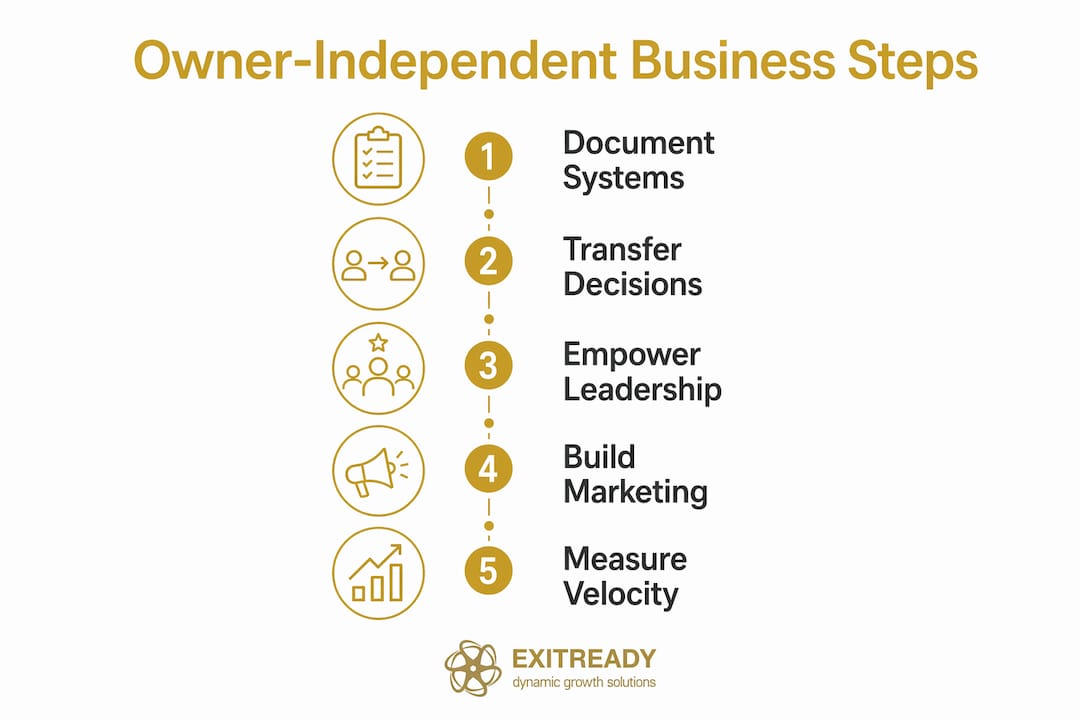
Owner independence does not happen by hiring good people and hoping for the best. It requires building five core pillars: operations, sales, marketing, finance, and HR. Each pillar needs a designated owner, documented step-by-step processes, and KPIs that allow performance to be measured without the owner’s interpretation.
Solomon Coaching describes this as a Company OS approach: a centralized documentation system that captures decision authority, escalation rules, and financial guardrails so leaders can act autonomously. Without explicit escalation rules, even well-documented processes leave managers guessing when edge cases arise. The result is that they default to asking the owner, and the bottleneck returns.
Marketing deserves special attention because it is the pillar most often left owner-dependent longest. Owner-dependent marketing relies on the owner’s personal referral network, their follow-up calls, and their presence at industry events. When the owner stops showing up, the pipeline dries up.
| Marketing type | How it works | Owner’s role |
|---|---|---|
| Owner-dependent | Personal referrals, owner-run follow-ups, network access | Daily execution and relationship management |
| Owner-independent | Automated lead capture, documented workflows, brand assets, team execution | Strategy and oversight only |
Owner-independent marketing means the marketing engine runs on repeatable channels: content marketing, paid acquisition, email automation, and CRM-driven follow-up sequences. The team executes campaigns using documented playbooks. Brand trust is built into assets like case studies, testimonials, and a consistent content calendar, not into the owner’s personal reputation alone.
Pro Tip: Before hiring more people, document every repeatable marketing task your team currently asks you to approve or initiate. That list is your first owner-independent marketing backlog.
Decision velocity is the operational metric that separates functional independence from theoretical independence. A business where managers must wait three days for owner approval on a $5,000 spend is still owner-dependent, regardless of how many processes are written down. KPI dashboards and pre-approved spending authorities give leaders the confidence to act, and they give the owner visibility without requiring involvement. Learning to work on your business rather than in it is the mindset shift that makes this possible.
Why owner independence is critical for business value and scalability
Valuation experts treat owner dependence as a quantifiable discount, not just a soft concern. When a buyer’s due diligence team discovers that the owner holds all key client relationships, approves all significant decisions, and is the face of the brand, they apply a key person discount to the purchase price. Simply Business Valuation confirms that due diligence confirms transferable systems as the standard test: if the business cannot demonstrate it operates independently of the owner, the valuation reflects that risk.
The financial mechanics work like this. A buyer who sees owner dependence will offer a lower upfront multiple and structure the deal with earnouts, meaning a portion of your sale price is paid only if revenue holds after you leave. If clients follow you out the door or operations stumble without you, you lose that deferred payment. The owner who built an independent business collects a higher upfront price with fewer contingencies.
Beyond exit value, owner independence is the precondition for scaling. A business that requires the owner’s judgment for every significant decision cannot grow faster than the owner can think. Hiring more people without transferring decision rights simply creates a larger team waiting for the same bottleneck. Solomon Coaching frames this shift as moving from Chief Everything Officer to architect: the owner designs the system, sets the strategy, and monitors results rather than executing daily work.
Scalability also benefits from the operational credibility that independence creates. When your leadership team can answer core operational questions during due diligence, when your processes are documented and your delegation maps are clear, you signal to investors, partners, and acquirers that the business has enterprise-grade infrastructure. That signal translates directly into higher valuation multiples and faster deal timelines. Dynamicgrowthsolutions works with mid-market owners specifically to build this kind of infrastructure through its AOS (Accelerated Operating System), which applies Fortune 500 methodology to companies that have outgrown founder-led management but have not yet built institutional systems.
What practical steps can owners take to build an owner-independent business?
Transitioning to an owner-free business model is a deliberate process, not a single decision. These steps give you a structured path.
- Map your five pillars. Identify the owner of each core function: operations, sales, marketing, finance, and HR. If you are the owner of more than two pillars, you have a concentration problem. Assign real authority, not just task responsibility, to each pillar leader.
- Document before you delegate. Every repeatable process you currently execute from memory needs to be written down before you hand it off. David Finkel’s framework in Inc. calls this systematizing daily work: capture the step-by-step logic, the decision criteria, and the exception-handling rules so the next person can execute without asking you.
- Transfer decision rights explicitly. Delegating tasks while retaining all decision rights keeps you as the bottleneck. Solomon Coaching identifies this as the most common failure mode: managers cannot make reversible decisions independently, so the business remains owner-dependent despite apparent delegation. Define spending authorities, hiring decisions, and client escalation thresholds in writing.
- Build a Company OS. Create a single source of truth for all processes, KPIs, org charts, and decision frameworks. Tools like Notion, Confluence, or a purpose-built business operating system work well for this. The goal is that any trained leader can find the answer to an operational question without calling you.
- Hire or engage a Fractional COO. If you lack the internal capacity to build systems while running the business, a Fractional COO accelerates the transition. This role specializes in turning founder-dependent operations into documented, scalable infrastructure. Eisemann Consulting’s work on operational scalability shows that systematization is the lever that converts founder-led firms into scalable enterprises.
- Test independence regularly. Take a one-week absence and track every decision that required your input. Each one is a gap in your system. Repeat quarterly until the list reaches zero.
Pro Tip: Align your company culture explicitly with autonomy and accountability. If your culture rewards people for checking with the boss before acting, your systems will never fully replace owner involvement regardless of how well they are documented.
Understanding the difference between working in versus on your business is the conceptual foundation for all six steps above.
Key takeaways
An owner-independent business is built on documented systems and transferred decision rights, not on hiring good people alone.
| Point | Details |
|---|---|
| Core definition | A business runs owner-independently when documented systems and empowered leaders sustain operations without the owner present. |
| Key person risk | Owner dependence lowers sale multiples and triggers earnout structures that reduce your net proceeds at exit. |
| Five-pillar framework | Assign real decision authority to owners of operations, sales, marketing, finance, and HR to distribute control. |
| Decision rights transfer | Delegating tasks without delegating decisions keeps the owner as a bottleneck regardless of team size. |
| Valuation impact | Due diligence confirms independence through transferable systems, delegation maps, and documented processes. |
The shift most owners resist the longest
Most owners I work with understand the concept of owner independence intellectually within the first conversation. The resistance shows up when it is time to actually hand over a decision they have always made themselves. That moment, when a manager makes a call you would have made differently and the outcome is still acceptable, is the real turning point.
The psychological shift from command-and-control to trust and verification is harder than building any process document. I have seen owners spend months creating beautiful Company OS documentation and then undermine it by answering every Slack message within minutes. The team learns quickly that the system is optional and the owner is still the real source of truth.
What actually works is a staged withdrawal. Start with low-stakes decisions. Let your operations lead approve vendor invoices under $10,000 without your sign-off for 90 days. Review the outcomes, not the decisions. When the results hold, expand the authority. This builds both the team’s confidence and your own trust in the system you have built.
The owners who reach genuine independence also share one trait: they hire for leadership capacity, not just functional skill. A great marketing manager who cannot make judgment calls under pressure will always escalate to you. A slightly less technically skilled manager with strong decision-making instincts will run the pillar autonomously. Hire for the latter, then build the systems around them.
The payoff is not just a higher sale price, though that matters. It is the experience of owning a business that generates value whether you show up or not. That is what exit readiness actually feels like from the inside.
— Andre
Ready to build a business that runs without you?
Dynamicgrowthsolutions helps mid-market owners replace owner dependency with documented systems, empowered leadership teams, and the operational infrastructure that commands premium valuations. The AOS (Accelerated Operating System) is a proven framework built specifically for businesses that have outgrown founder-led management.
If you want to understand the foundation of an owner-independent operation, start with the business operating system guide on the Dynamicgrowthsolutions site. It explains exactly how a structured operating system replaces owner muscle memory with repeatable, scalable processes. For owners who want to accelerate the journey with peer-level accountability, the CEO mastermind events bring together mid-market leaders working through the same transition.
FAQ
What does owner-independent mean for a business?
Owner-independent means the business sustains normal operations, revenue, and decision-making without the owner’s daily involvement. It relies on documented systems, empowered leaders, and clear decision authority rather than the owner’s personal judgment.
How long does it take to create a self-sustaining business?
The timeline depends on the current level of documentation and leadership depth, but most mid-market businesses require 12 to 36 months of deliberate system-building to reach genuine owner independence. Starting with the five-pillar framework and decision rights transfer accelerates the process significantly.
How does owner independence affect business valuation?
Owner dependence triggers a key person discount that reduces upfront sale multiples and forces buyers to structure deals with earnouts tied to post-sale revenue retention. Businesses with transferable operating systems command higher prices and cleaner deal structures.
What is the most common mistake when building owner independence?
The most common failure is delegating tasks while retaining all decision rights. When managers cannot make reversible decisions independently, the owner remains the bottleneck regardless of how many people are on the team or how many processes are documented.
Can owner-independent marketing work for a small business?
Yes. Owner-independent marketing replaces personal referrals and owner-run follow-ups with automated lead capture and documented campaign workflows. Even a two-person marketing function can operate independently when the processes, brand assets, and CRM sequences are properly built out.