

Business systems thinking is the discipline of analyzing an organization by examining the relationships, feedback loops, and structures that shape its collective behavior. Rather than treating departments or functions as isolated units, this approach recognizes that decisions in one area create trade-offs and ripple effects across the entire organization. Peter Senge, author of The Fifth Discipline, popularized the concept in the early 1990s, and it has since become a foundational lens for leaders who want to solve recurring problems at their root rather than their surface. For business owners and entrepreneurs, understanding systems thinking is the difference between constantly fighting fires and building an organization that regulates itself.
What does business systems thinking mean in practice?
Business systems thinking means shifting your analytical focus from individual components to the connections between them. A sales team missing quota is not just a sales problem. It may reflect a pricing structure that undercuts perceived value, a product feedback loop that delays improvements, or a hiring process that selects for the wrong skills. Structure drives behavior in any organization, which means changing the structure changes the outcomes, not just the people inside it.
The concept rests on a few foundational ideas that distinguish it from conventional management thinking:
- Stocks and flows: Stocks are the measurable quantities in your business, such as cash, staff headcount, or customer relationships. Flows are the rates at which those stocks change. Understanding what fills or drains each stock reveals where your business is gaining or losing ground.
- Feedback loops: Reinforcing loops amplify change in one direction. A growing reputation attracts more clients, which funds better delivery, which strengthens reputation further. Balancing loops resist change and push systems toward equilibrium, like a hiring freeze that kicks in when payroll exceeds a threshold.
- Delays: The gap between a cause and its visible effect is where most leaders make their worst decisions. A marketing campaign launched today may not show revenue impact for 90 days. Acting impatiently before the delay resolves creates oscillation and wasted resources.
- Leverage points: These are the places in a system where a small, well-placed intervention produces outsized change. Identifying them is the core skill of systems thinking.
Pro Tip: Draw a simple causal loop diagram for your single most recurring operational problem before your next leadership meeting. Even a rough sketch of causes and effects will surface connections your team has never discussed.
How does systems thinking improve operational efficiency?
Applying systems thinking to operations changes how you diagnose problems and where you intervene. Most leaders default to what researchers call “fixes that fail,” addressing the visible symptom without touching the underlying structure. The symptom improves briefly, then returns, often worse than before.
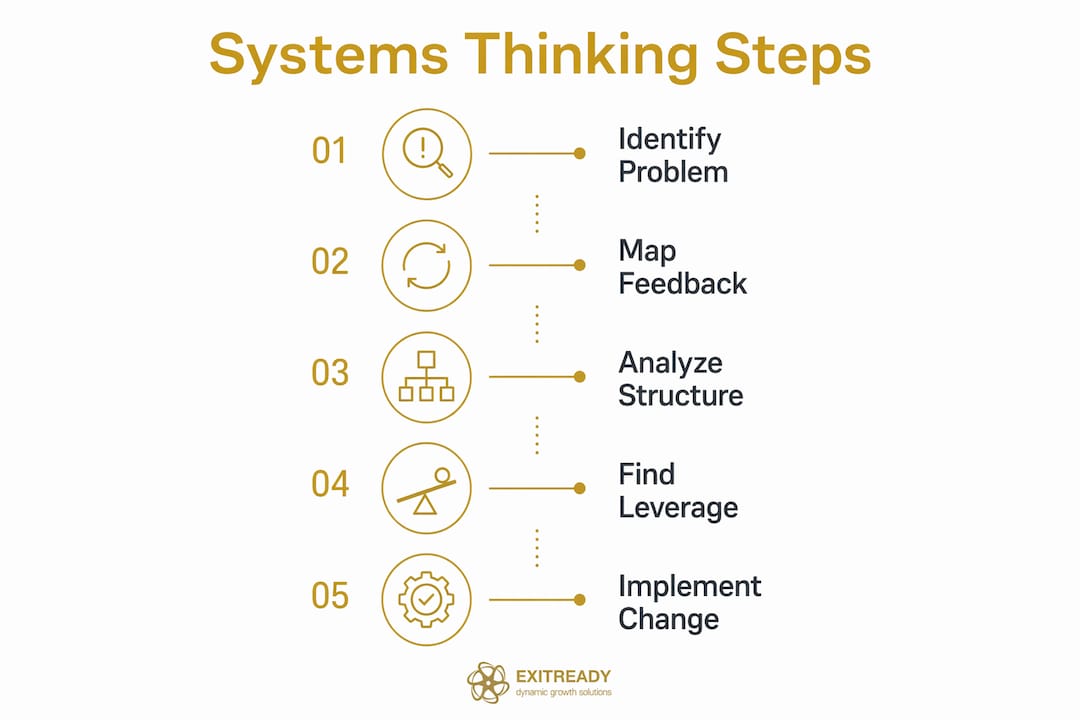
Here is a practical sequence for applying systems thinking to operational decisions:
- Map the problem, not the symptom. Identify the recurring pattern. Is customer churn rising every Q3? Is production quality dropping whenever you onboard new staff? The pattern is the signal that a structural dynamic is at work.
- Trace causal links. Ask what directly causes the pattern, then ask what causes that cause. Keep going until you reach a structural variable you can actually change, such as a policy, a goal, or a feedback mechanism.
- Identify reinforcing and balancing loops. Determine whether the system is amplifying the problem or trying to correct it. This tells you whether you need to dampen a runaway loop or strengthen a corrective one.
- Locate the leverage point. Small interventions at leverage points shift system behavior more effectively than large-scale symptom fixes. A change to how performance data is reported, for example, can alter behavior across an entire organization.
- Account for delays before acting. Measuring lag times between actions and effects prevents overcorrection. If you increase marketing spend and see no results in two weeks, the answer is rarely to double the spend again.
The operational payoff is significant. Leaders who apply this sequence stop recycling the same problems through quarterly reviews and start building processes that self-correct. You can see systematized business processes that scale precisely because they were designed with feedback loops in mind rather than bolted together reactively.
Pro Tip: When a problem resurfaces for the third time, treat it as a structural signal, not a personnel issue. The system is telling you something about its own design.
What tools and methods help leaders practice systems thinking?
Systems thinking is not purely conceptual. Several practical tools make it tangible and usable in leadership settings.
| Tool | Best used for | Skill level required |
|---|---|---|
| Causal loop diagrams | Mapping feedback relationships visually | Beginner to intermediate |
| Stock and flow diagrams | Quantifying system dynamics over time | Intermediate to advanced |
| Iceberg model | Identifying root causes beneath visible events | Beginner |
| Behavior over time graphs | Spotting patterns and oscillations | Beginner |
The iceberg model is particularly useful for leaders new to systems thinking. The visible tip of the iceberg represents the event, the thing that just happened. Below the surface sit patterns, then structures, then the mental models that created the structure. Most organizations spend all their energy at the tip. Systems thinkers work below the waterline.
Causal loop diagrams are the workhorse of the discipline. They map variables as nodes and draw arrows showing how each variable influences others, with labels indicating whether the relationship is reinforcing or balancing. A completed diagram of even a modest business process will typically reveal three or four feedback loops that no one on the team had consciously recognized.

Embedding systems thinking cross-functionally is what separates organizations that use it as a one-time exercise from those that institutionalize it. When finance, operations, sales, and product teams each contribute their perspective to a causal map, the resulting picture is far more accurate than any single function could produce alone.
Common misconceptions about business systems thinking
Several misunderstandings consistently derail leaders who try to adopt this approach.
- Expecting linear cause and effect. The most common mistake is assuming that action A will produce result B in a predictable, proportional way. Systems produce dynamic responses over time, not instant, linear outputs. A price increase does not simply reduce volume by a fixed percentage. It triggers competitor responses, customer perception shifts, and internal cost structure changes simultaneously.
- Confusing symptoms with root causes. Treating high employee turnover as a recruitment problem when it is actually a management structure problem is a classic example. Systems thinking shifts focus from “what caused this event?” to “what structure is producing this recurring pattern?”
- Ignoring delays. Leaders who do not account for feedback delays end up overcorrecting. They increase inventory because supply looks short, the delayed shipments arrive, and suddenly they are overstocked. This oscillation is a direct product of unrecognized delay.
- Treating it as a one-time project. Systems thinking is not a workshop you run once. Practicing it builds a leadership muscle that grows stronger with repeated application across different business contexts.
- Underestimating cultural resistance. Structural interventions often challenge existing power dynamics, reporting relationships, or long-held assumptions. Durable change requires culture to support systemic awareness, not just executive sponsorship of a new framework.
How to start applying systems thinking in your organization
You do not need a consulting engagement or a software platform to begin. The entry point is a single recurring problem that your team has failed to solve permanently.
- Pick one problem with a history. Choose something that has come back at least twice despite previous fixes. This signals a structural dynamic rather than a one-time event.
- Assemble a cross-functional group. Invite people from at least three different functions. Each brings a different view of the same system, and the intersections between those views are where the real insights live.
- Build a causal map together. Start with the symptom and work backward. Ask “what directly influences this?” at each step. Resist the urge to assign blame. Focus on variables and relationships, not people.
- Identify your highest-leverage intervention. Look for the variable that appears in multiple feedback loops. Changing it will affect the system in several places at once. This is your leverage point.
- Monitor feedback loops deliberately. Set a review cadence that accounts for the delay in your system. If your sales cycle is 60 days, do not evaluate a structural change after two weeks. Build patience into the process.
- Embed it into leadership routines. The goal is for systemic thinking to become part of how your leadership team makes decisions, not a separate analytical exercise reserved for crises.
Key takeaways
Business systems thinking produces durable operational improvements only when leaders address structural causes rather than surface symptoms, account for feedback delays, and embed the practice across all functions.
| Point | Details |
|---|---|
| Structure drives behavior | Changing policies, goals, and feedback mechanisms produces lasting change; changing people alone does not. |
| Feedback loops shape outcomes | Reinforcing loops amplify trends while balancing loops resist change; identifying both is critical for accurate diagnosis. |
| Delays cause most overcorrections | Measuring the lag between action and effect prevents the oscillations that waste resources and erode confidence. |
| Leverage points beat symptom fixes | Small, well-placed structural interventions outperform large-scale responses to visible problems. |
| Cross-functional practice is required | Systems thinking applied within a single silo produces an incomplete and often misleading picture of the organization. |
Why most leaders are solving the wrong problem
I have worked with enough mid-market business owners to recognize a pattern that almost never gets named directly. The leaders who struggle most are not the ones lacking intelligence or effort. They are the ones solving the problem they can see rather than the one that is actually running the show.
One owner I worked with had replaced his operations manager three times in four years. Each time, the first six months looked promising. Then the same bottlenecks reappeared, the same customer complaints surfaced, and the same team frustrations boiled over. He was convinced he had a people problem. What he actually had was a decision-making structure that funneled every non-routine issue to one person, guaranteed that person would burn out, and reset the cycle. The leverage point was not the manager. It was the approval threshold policy that had never been updated since the company had five employees.
That is what systems thinking actually looks like in practice. It is not a whiteboard exercise. It is the discipline of staying curious long enough to find the structure behind the pattern. The leaders I have seen apply it well share one trait: they are genuinely more interested in understanding the system than in being right about their initial diagnosis. That patience is not a personality type. It is a skill, and it compounds over time.
If you want to build an organization that does not depend on your constant intervention, start by understanding what the system is doing and why. The answer is almost never where you first looked.
— Andre
Build a business that runs on systems, not on you

The principles covered in this article are the foundation of what Dynamicgrowthsolutions applies through its AOS (Accelerated Operating System) for mid-market business owners. Understanding feedback loops and leverage points is step one. Translating that understanding into documented processes, delegated decision-making, and self-correcting operations is where the real value is built. If you are ready to move from reactive management to a business that scales without your constant presence, explore how business management systems create the operational independence that makes companies both more profitable and more attractive to buyers. You can also review the AOS entrepreneur program to see whether it fits your current stage.
FAQ
What is the simplest definition of business systems thinking?
Business systems thinking is the practice of analyzing an organization by focusing on the relationships and feedback loops between its parts rather than the parts themselves. It reveals why recurring problems persist and where structural changes will have the greatest impact.
How is systems thinking different from standard business analysis?
Standard analysis typically examines components in isolation, such as a department’s performance or a single metric. Systems thinking maps how those components interact, including feedback delays and unintended consequences, to diagnose structural causes rather than surface events.
What is a leverage point in systems thinking?
A leverage point is a place in a system where a small, targeted intervention produces significant change across multiple feedback loops. Identifying leverage points is the primary goal of causal mapping in a business context.
Why do feedback delays matter for business decisions?
Feedback delays create a gap between when a decision is made and when its effects become visible. Leaders who ignore this gap tend to overcorrect, which generates oscillations in performance rather than stable improvement.
Can small businesses benefit from systems thinking?
Systems thinking applies at any organizational scale. For smaller businesses, the causal maps are simpler, but the structural dynamics, including reinforcing loops and feedback delays, operate the same way and produce the same recurring problems when left unexamined.