

Most mid-market business owners significantly underestimate how much time effective timeline planning for a business exit actually requires. You might assume you need six months, maybe a year. The reality is that exit preparation spans 3 to 5 years at minimum, covering everything from financial cleanup and operational restructuring to legal readiness and buyer positioning. Start too late and you either leave money on the table or get forced into a rushed deal you didn’t want. This guide breaks down exactly what your exit strategy roadmap should look like and when each phase needs to begin.
Key takeaways
| Point | Details |
|---|---|
| Start 3 to 5 years early | Beginning your exit preparation well in advance can increase your final sale price by up to 30%. |
| Reduce owner dependency first | Building operations that run without you typically takes 12 to 24 months and directly boosts buyer confidence. |
| Due diligence takes longer than expected | Budget 45 to 90 days for buyer due diligence and prepare all documentation before going to market. |
| Financial records are non-negotiable | Buyers require 3 to 5 years of clean financials; gaps or inconsistencies are the most common deal-killers. |
| Compressed timelines hurt valuations | Skipping preparation phases can reduce your valuation by 30 to 50% and shrink your buyer pool significantly. |
Timeline planning for your business exit starts with clear goals
Before you build any exit strategy timeline, you need to know what you actually want from the exit. This sounds obvious, but most owners skip it. They think “I want to sell for as much as possible” is a goal. It isn’t. It’s a preference without a plan.

Start by asking yourself three questions. First, what is your target exit date? Second, what minimum net proceeds do you need after taxes and transaction costs to fund your post-exit life? Third, how involved do you want to be after the deal closes?
Your answers to these questions directly shape every decision in your exit strategy roadmap. An owner who wants a clean break in two years needs a very different plan than someone open to a five-year earnout with gradual transition. The exit speed options generally fall into three categories:
- Immediate exit: You sell and walk away within 12 to 18 months of deciding. This path demands that the business already operates independently of you, which for most owners means significant pre-work has already been done.
- Gradual exit: You spend two to four years building systems, transitioning leadership, and preparing for a sale at peak value. This is the most common and most profitable path.
- Assisted transition: You sell but remain involved in a consulting or employment role for one to three years post-close. This is often required when buyer confidence in the management team is lower.
Pro Tip: The moment you define your target exit year, work backward to assign deadlines to every preparation milestone. Treat those deadlines as seriously as any client contract.
Early decision-making controls the entire process. Owners who wait until an external event, a health issue, a competitor acquisition, or market pressure, to begin planning almost always exit at a discount. You want the luxury of timing the market rather than being forced by it.
Building value in the multi-year preparation phase
This is where the real work happens, and where most owners are surprised by the scope. The multi-year preparation phase, typically starting three to five years before your intended exit, focuses on making your business more valuable and more transferable.
Here is a practical sequence for what to work through:
- Profit improvement. Identify and fix margin leaks before a buyer finds them first. Clean up the P&L by removing personal expenses and normalizing owner compensation to market rate. This creates a defensible and accurate EBITDA picture.
- Operational independence. High owner dependency results in valuation discounts because buyers see a key-person risk. Document your processes, delegate decisions, and build a management layer that runs daily operations without you. This alone typically takes 12 to 24 months.
- Financial cleanup. Close your books monthly within 10 days and maintain CPA-reviewed financials for at least 24 months before going to market. Skipping this workstream can cost 0.5 to 1.5 times your EBITDA at exit.
- Customer and revenue diversification. Buyers discount heavily when one customer represents more than 20% of revenue. Reducing customer concentration is a multi-year task that cannot be rushed before a sale.
- Management and staff development. The buyer needs to trust that your team can execute without you. Invest in leadership development, cross-training, and documented succession plans at least two years out.
- Professional business valuation. Get your first independent valuation 18 to 24 months before your planned exit. This gives you a benchmark and time to close the gap between where you are and where you want to be.
- Tax and estate planning. Tax planning should begin three to five years before your exit. Structures like pre-sale gifting, trust arrangements, and entity restructuring require lead time. Waiting until 12 months out eliminates most of your options.
Pro Tip: Commission a sell-side Quality of Earnings (QoE) analysis six months before going to market. It surfaces the issues buyers will find during diligence so you can address them first instead of negotiating under pressure.
The comparison below shows how preparation timing affects your outcome:
| Preparation start | Typical outcomes |
|---|---|
| 4 to 5 years before exit | Maximum valuation, full buyer pool, strong negotiating position |
| 2 to 3 years before exit | Good outcomes possible, some limitations on deal structure |
| 12 to 18 months before exit | Moderate outcomes, fewer fixes possible, compressed buyer confidence |
| Less than 6 months before exit | Significant valuation discounts, deal-killers often unresolved |
Active sale execution and the 12 to 24 month window
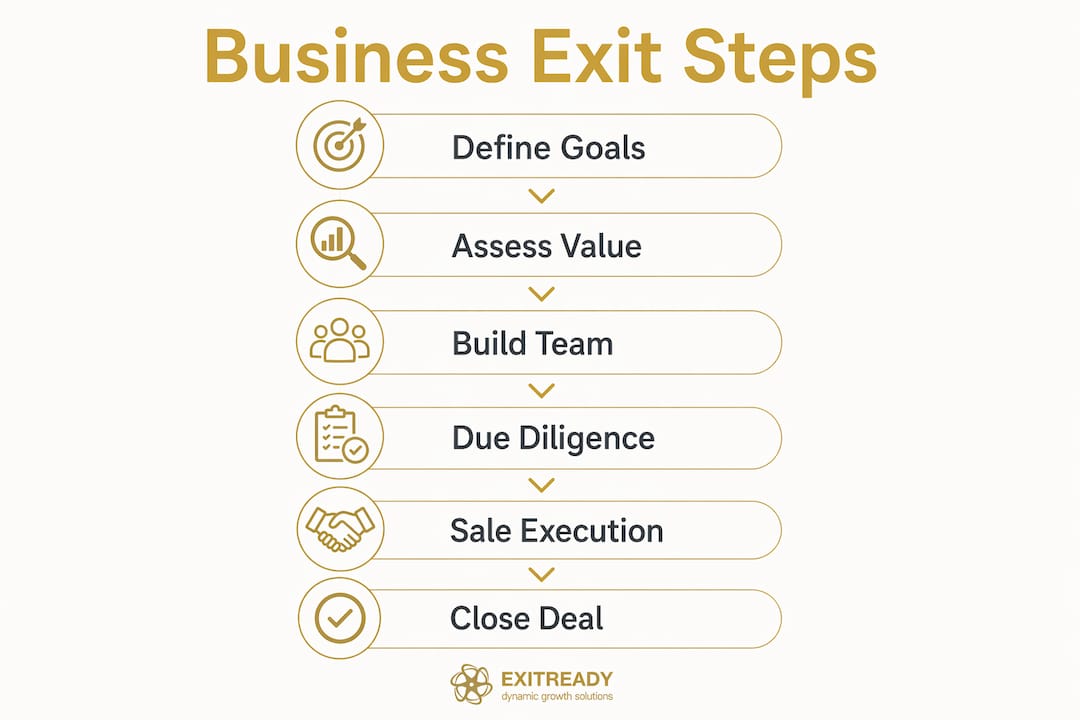
Once your business is prepared, you enter the active phase of the business sale timeline. This stage spans roughly 12 to 24 months from going to market through closing. Most sellers underestimate how long it takes and how mentally demanding it is.
Here is what the active phase looks like in sequence:
- Positioning and marketing. Working with your M&A advisor or broker, you prepare the Confidential Information Memorandum (CIM) and identify your target buyer universe. Whether that’s strategic buyers, private equity, or family offices matters enormously, and understanding types of business buyers early helps you tailor your pitch accordingly.
- Buyer outreach and indications of interest. Running a structured process with multiple buyers simultaneously creates competitive tension and protects your pricing. Single-buyer processes almost always result in lower prices and weaker terms.
- Letter of Intent (LOI). Receiving and negotiating an LOI is a major milestone, but it is not a finish line. An LOI is non-binding, and deals still fall apart after signing. Negotiate the key economic and structural terms carefully here because reopening them later is painful.
- Due diligence. The LOI to closing timeline typically runs four to seven months. Diligence alone accounts for 45 to 90 days of that window.
- Closing and post-closing transition. Most deals include a transition period of six to 24 months where you remain involved in some capacity, whether through employment, consulting, or an earnout structure.
The most important thing to understand about this phase: compressing it hurts you. Rushing from LOI to close without adequate diligence preparation creates problems that buyers use to renegotiate price at the last minute. You lose leverage exactly when you need it most.
Due diligence preparation and what buyers actually examine
Due diligence is where the deal lives or dies. A business that looked great in the CIM can fall apart in diligence if the underlying documentation is disorganized, inconsistent, or missing entirely.
Buyers examine your business in layers. Financial, legal, operational, commercial, tax, and human capital reviews all happen simultaneously and require you to respond accurately and quickly. Delays or incomplete answers erode buyer confidence fast.
Here is what you should have ready before a single buyer signs an NDA:
- Three to five years of audited or CPA-reviewed financial statements
- All customer and vendor contracts, with any change-of-control clauses flagged
- Corporate formation documents, equity records, and any outstanding legal matters
- Employee compensation data, benefits summaries, and key employment agreements
- Intellectual property documentation, licenses, permits, and regulatory filings
- A working capital analysis and detailed revenue breakdown by customer, product, and geography
Organized sellers close deals 30 to 40% faster and face far fewer renegotiations. That speed advantage matters because time kills deals. Every week a deal sits in diligence is another week something can go wrong.
Pro Tip: Run a mock due diligence exercise 12 months before going to market. Assign someone on your team or hire an advisor to play the role of a skeptical buyer and request your own documentation package. You will find gaps you never expected.
The Quality of Earnings analysis deserves special attention. Buyers use it to verify that your reported earnings are real, recurring, and defensible. A well-prepared QoE tells your financial story in the most favorable but accurate light. Without it, buyers fill information gaps with worst-case assumptions, which directly reduces what they will pay.
My take on why most owners get the timeline completely wrong
I’ve worked with enough mid-market owners to see a clear pattern. Almost everyone thinks their exit will take less time than it does and will be easier than it is. That’s not pessimism. It’s just what I’ve consistently observed.
The most expensive mistake I see is owners treating exit planning like a transaction rather than a transformation. They start thinking about selling and immediately focus on finding a buyer. But the business isn’t ready. The financials are messy, the owner is the business, and there’s nothing a buyer can verify without taking a leap of faith. That’s not a foundation for a premium price.
What actually works is thinking about your exit readiness the same way you think about building any other asset. You invest in it, you improve it over time, and you don’t liquidate it before it has matured. Owners who start this process four or five years out have time to fix things. They have time to grow revenue in ways that make sense to buyers, reduce concentration risk, and build a management team that buyers want to retain.
The other thing I want to push back on is the idea that personal readiness doesn’t matter. I’ve seen owners sabotage otherwise good deals because they weren’t emotionally ready to let go. Getting clear on your life after the exit, what you’ll do, how you’ll spend your time, what success looks like for you personally, is just as important as getting the EBITDA multiple right.
Start early. Build systems. Make the business work without you. That’s the whole game.
— Andre
How Dynamicgrowthsolutions helps you exit on your terms

If you’ve read this far and recognized gaps in your own exit timeline, you’re not alone. Most mid-market owners are running operations that depend too heavily on them, with financials that wouldn’t survive buyer scrutiny and no documented systems to transfer knowledge. Dynamicgrowthsolutions was built specifically to solve this problem.
Through the AOS (Accelerated Operating System), Dynamicgrowthsolutions helps owners build business management systems for sustainable growth that reduce owner dependency, document operations, and position the business for a premium exit. Whether you’re three years out or actively preparing to go to market, the platform connects you with advisors, fractional executives, and a buyer network to accelerate your readiness. Explore the entrepreneur application for exit readiness to see where you stand today.
FAQ
How long does business exit planning typically take?
Most mid-market business exits require three to five years of preparation, followed by a 12 to 24-month active sale process. Starting too late is the single most common cause of reduced valuations.
What is the LOI to closing timeline for a business sale?
The period from signing a Letter of Intent to closing typically takes four to seven months, with buyer due diligence accounting for 45 to 90 days of that window.
What do buyers review during due diligence?
Buyers examine three to five years of financial statements along with legal documents, customer contracts, employee records, IP filings, and operational data across financial, legal, and commercial workstreams.
How does owner dependency affect my business sale price?
High owner dependency signals key-person risk to buyers and results in valuation discounts. Building a management team that runs operations independently typically takes 12 to 24 months and directly improves your final sale price.
When should I start tax planning for a business exit?
Tax and estate planning should begin three to five years before your intended exit date. Pre-sale gifting, trust structures, and entity arrangements require advance lead time. Starting within 12 months significantly limits your options.