

Most business owners hear “business operating system” and picture software. That instinct makes sense, but it leads you in the wrong direction. What is a business operating system, really? It’s a documented framework of processes, workflows, roles, and shared standards that tells your company exactly how to operate at every level. Think of it as the rulebook your team runs by, whether you’re in the room or not. This article breaks down the business OS definition, its core components, how it compares to tools like ERP and CRM, and exactly how to build one that drives real operational independence.
Table of Contents
- Key takeaways
- What a business operating system actually is
- The five-layer framework of a BOS
- How a BOS differs from ERP and CRM
- How to implement a business OS step by step
- Benefits of a business operating system for scaling
- My take on what most owners get wrong
- How Dynamicgrowthsolutions helps you build your BOS
- FAQ
Key takeaways
| Point | Details |
|---|---|
| BOS is a framework, not software | A business operating system organizes how your company runs through documented processes and shared standards. |
| Five layers drive the system | Pipeline, Delivery, Reporting, Finance, and Knowledge management are the core interconnected layers of any working BOS. |
| Discovery comes before everything | Mapping real workflows before designing your system prevents costly rework and failed implementations. |
| BOS outperforms isolated tools | Spreadsheets and standalone software cannot replace a true business management system built on documented, connected workflows. |
| Scalability requires operational independence | A well-built BOS lets your team execute consistently without relying on founder memory or improvisation. |
What a business operating system actually is
The term “business operating system” gets used loosely, so let’s ground it with a working business OS definition. A business operating system (commonly called a BOS) is a documented playbook that bridges vision and execution across your entire organization. It captures how decisions get made, how work moves through departments, and how performance gets measured.
Unlike software, a BOS is not something you install. It’s something you design and embed into the culture of your company. It covers:
- Roles and responsibilities: Who owns what, with no ambiguity
- Workflows and processes: Step-by-step documentation for how recurring work gets done
- Communication standards: How teams report, escalate, and collaborate
- Metrics and KPIs: What numbers matter and how you track them
- Tool alignment: Which software supports each function and why
One reason spreadsheets fall short of a real BOS is that they lack connection, automation, and documentation across functions. A spreadsheet captures data. A BOS creates context around that data so the whole team can act on it without needing to ask you for interpretation every time.
Pro Tip: Before you call anything a “system,” ask one question: Can a new hire follow it without asking for help? If the answer is no, it’s still just a habit, not a process.
The design of your BOS is always specific to your organization. A 12-person consultancy operates differently than a 120-person logistics firm. But both need the same ingredients: clarity, documentation, and shared understanding that travels beyond the founder’s head.
The five-layer framework of a BOS
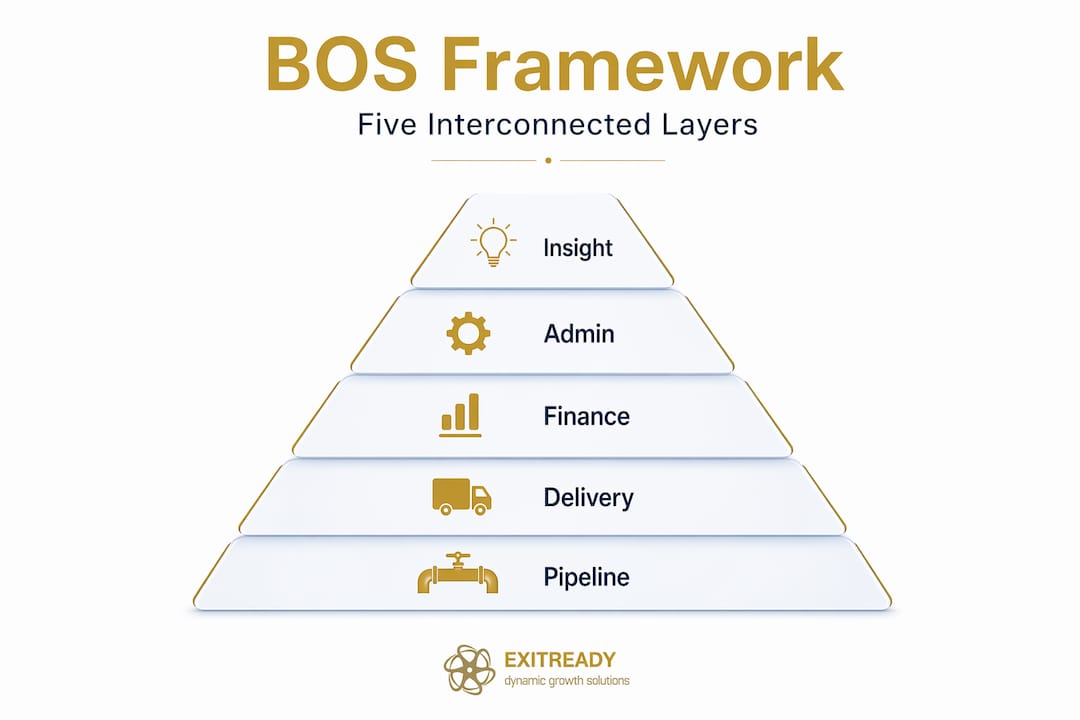
Most companies trying to build a business operating system get confused about scope. They document a few processes and call it done. A functional BOS has five interconnected layers, each serving a distinct operational purpose.
| Layer | Function | Tools that typically support it |
|---|---|---|
| Pipeline | Sales system, lead tracking, conversion | CRM, proposal software |
| Delivery | Project management, task execution | Project management platforms |
| Reporting | Dashboards, performance tracking | BI tools, scorecards |
| Finance | Cash flow visibility, expense management | Accounting software, FP&A tools |
| Knowledge | SOPs, playbooks, onboarding documentation | Wiki platforms, LMS tools |
Each layer feeds the others. Your Pipeline layer captures a new client. Your Delivery layer activates the project. Your Finance layer invoices and tracks payment. Your Reporting layer tells you whether the engagement was profitable. Your Knowledge layer holds the documented process so the next client engagement runs the same way without reinvention.

Automation between layers using tools like Make.com or Zapier is what makes the whole system self-sustaining rather than manually dependent. When a deal closes in your CRM, it can automatically trigger a project in your delivery tool, generate a contract, and notify the relevant team members. That’s not magic. That’s a connected BOS.
Pro Tip: Don’t build all five layers at once. Identify your biggest operational bottleneck first, build that layer properly, then expand. Trying to do everything simultaneously usually means nothing gets finished.
The information flow across these five layers is what prevents the duplication, errors, and delays that quietly drain your margins every quarter. Without this structure, information lives in emails, in people’s heads, and in disconnected tools that never talk to each other.
How a BOS differs from ERP and CRM
This is where most business owners get genuinely confused, so it’s worth spending time here. ERP systems manage internal operations like finance, supply chain, and HR. CRM systems manage external customer interactions. Both are software platforms with defined scope. A BOS is the operational framework that sits above both of them.
Here’s the clearest way to think about it:
- ERP answers the question: “What are our internal resources and how are they allocated?”
- CRM answers the question: “Who are our customers and where are they in our sales process?”
- BOS answers the question: “How does our company operate, decide, and execute at every level?”
A BOS can incorporate both ERP and CRM as tools within its layers. The Finance layer of your BOS might run on your ERP. The Pipeline layer might live in your CRM. But neither tool constitutes the BOS itself. The BOS is the logic, documentation, and standards that govern how those tools are used and how the outputs connect to each other.
Relying on software without an operating framework is like having a state-of-the-art kitchen with no recipes. You have the equipment, but no one agrees on how to use it. Companies that treat their CRM as their operating system end up with excellent contact records and no operational discipline. The operating system for businesses that actually produces scale is the documented framework underneath the software.
How to implement a business OS step by step
Building and implementing a BOS in a real company typically takes 90 to 120 days when executed with focus. Here’s how that process breaks down.
- Discovery. Map how your business actually operates today. Not how you wish it worked. Pull your team into honest conversations about what really happens when a lead comes in, when a project starts, when something breaks. This is where most implementations fail. Skipping discovery leads to documenting ideal workflows rather than real ones, which means your system will never get adopted.
- System design. Take your discovery findings and design the five layers with scope and priorities defined. Decide which layer needs the most urgent attention and which tools you’ll use to support each one. Do not choose tools before this step.
- Build. Document processes, assign ownership, configure your tools, and create the templates and playbooks your team will use. This is where your Knowledge layer gets populated.
- Automate. Connect your tools and create automated triggers between layers. A closed deal triggers delivery setup. A completed project triggers an invoice. An overdue task triggers a notification. Automation multiplies the value of documentation.
- Train and hand over. Your BOS only works if your team knows how to use it. Training programs with clear certification for role-specific knowledge transfer make the difference between a BOS that sticks and one that gets abandoned in week three.
Pro Tip: Buying software before completing discovery is the single fastest way to waste money and lose momentum in a BOS rollout. Discovery comes first. Tools come after.
A common mistake business owners make at this stage is ignoring how their clients actually communicate. Your Delivery layer might be built around a project management platform, but if your clients send everything by email, your BOS needs to account for that reality. Build for how people actually behave, not how you’d prefer they behave.
Benefits of a business operating system for scaling
Once your BOS is operational, the compounding returns become visible quickly. Here’s what changes:
- Alignment across the organization. Every team member understands their role, their metrics, and how their work connects to company objectives. No more interpretation required.
- Fewer errors and duplicated effort. Documented workflows eliminate the “I thought you were handling that” problems that waste hours every week.
- Faster, better onboarding. New hires follow documented processes from day one. Training time drops and performance ramps faster.
- Data-driven decisions. Your Reporting layer surfaces real performance data, so you stop guessing and start deciding based on what’s actually happening.
- Founder independence. A BOS that runs on systems, not memory means your team executes without requiring your constant input.
That last point is the most consequential for scaling. The momentum created by a structured BOS prevents organizations from depending on leadership improvisation, which is the single biggest ceiling on growth for most mid-market businesses. When your company can execute without you, it becomes genuinely scalable. And when it’s genuinely scalable, it becomes valuable to acquirers, investors, and strategic partners. If exit readiness matters to you, operational independence is where the work starts.
My take on what most owners get wrong
I’ve worked with enough businesses to know that the discovery phase is almost always underestimated. Owners assume they know how their company operates because they built it. But there’s a consistent gap between what founders believe happens and what actually happens when they’re not watching. The processes that exist in writing are rarely the processes people follow on Tuesday afternoon.
The other trap I see constantly is automating broken workflows. Owners get excited about automation tools and start connecting their systems before they’ve cleaned up the underlying processes. The result is a faster, more consistent version of the same problem. Garbage in, garbage out, just more efficiently.
What I’ve learned is that the companies who get BOS right treat the discovery phase like an audit. They talk to frontline team members, trace a real client from inquiry to invoice, and document what’s actually happening. Then they design the system to improve that reality rather than replace it with a fantasy.
When a BOS is implemented well, the owner stops being the answer to every question. I’ve seen founders reclaim ten or more hours a week within the first 60 days. Not because they hired more people, but because the system started doing the thinking that used to live only in their heads.
— Andre
How Dynamicgrowthsolutions helps you build your BOS
Dynamicgrowthsolutions works with mid-market owners who are done improvising and ready to operate with the discipline that actually drives scale. Through the AOS (Accelerated Operating System) program, Dynamicgrowthsolutions guides you through every phase of designing and implementing a business management system built for your specific business. You get documented playbooks, tool configuration, team training, and a system your company can run without you in every meeting. If you’re serious about scaling your company or preparing for a premium exit, the AOS application is the right starting point.
FAQ
What is the business OS definition in simple terms?
A business operating system is a documented framework of processes, roles, and standards that governs how a company operates day to day. It’s the underlying logic that turns goals into consistent execution across every team.
How is a BOS different from software like ERP or CRM?
ERP manages internal resources and CRM manages customer interactions, but a BOS is the overarching operational framework that determines how those tools are used and how all functions connect to each other.
What are the types of business operating systems?
Business operating systems generally fall into proprietary frameworks like EOS (Entrepreneurial Operating System), custom-built systems, or hybrid approaches. All share the same core components: documented processes, defined roles, metrics, and knowledge management.
How long does it take to implement a business OS?
A focused BOS rollout typically takes 90 to 120 days, covering discovery, design, build, automation, and team training in sequential phases.
What are the main benefits of a business operating system?
A well-built BOS reduces errors, accelerates onboarding, creates data-driven reporting, and enables your team to execute independently, removing the founder as the operational bottleneck and positioning the business for scalable growth.