

Most mid-market business owners treat assessments as an annual obligation, something you do to satisfy a board, an investor, or a year-end checklist. That framing is costing them. The role of business assessments in growth is far more consequential than compliance or reporting. Done right, assessments function as diagnostic intelligence, revealing exactly where your business leaks money, stalls execution, and ties the owner to daily decisions that a well-built system should handle automatically. This article shows you how to use assessments as a genuine growth tool, not a formality.
Table of Contents
- Key Takeaways
- The role of business assessments in growth starts with defining them correctly
- How assessments uncover growth opportunities and operational waste
- Timing and frequency: making assessments a continuous discipline
- Practical steps for turning assessments into growth plans
- Measuring the impact: what good assessments actually improve
- My take on why most owners underuse their best diagnostic tool
- Start using assessments to build a business that scales without you
- FAQ
Key Takeaways
| Point | Details |
|---|---|
| Assessments go beyond audits | A true business assessment examines strategy, leadership, processes, culture, and financials as an integrated system. |
| Frequency matters | Comprehensive reviews every 2-3 years combined with quarterly pulse checks prevent blind spots from accumulating. |
| Findings must become plans | Assessments only drive growth when converted into prioritized, measurable action plans with clear ownership. |
| Owner dependency is a growth ceiling | Assessments identify where leadership gaps and undocumented processes keep the owner trapped in the business. |
| Metrics confirm the impact | Profit, revenue, efficiency, and employee engagement all improve when assessments are applied consistently. |
The role of business assessments in growth starts with defining them correctly
Most business owners have completed a financial audit. Some have done an HR review. Very few have conducted a true organizational assessment, and that gap explains a lot of stalled growth.
Business assessments evaluate processes, people, and organizational structure to uncover inefficiencies and opportunities that isolated audits simply miss. A financial audit tells you what happened with your numbers. An organizational assessment tells you why it happened and what structural conditions are holding back better results.
The core components of a thorough assessment include:
- Strategy and direction: Are your goals clear, communicated, and actually driving decisions at every level?
- Leadership and culture: Is your leadership team aligned, capable, and building the right environment for execution?
- Processes and workflows: Are your core operations documented, repeatable, and scalable without the owner involved?
- Technology and systems: Are your tools actually accelerating work, or are they creating more complexity?
- Financial health: Are your margins, cash flow, and capital allocation supporting the growth you are targeting?
The power of examining these elements together is that you start seeing systemic issues rather than isolated problems. A company struggling with slow delivery might blame the logistics team. But an assessment often reveals the root cause is a culture of unclear accountability that starts at the leadership level. Fixing the symptom without addressing the system produces temporary results at best.
Pro Tip: Before scheduling an assessment, map out which business decisions currently require your personal sign-off. That list is your first diagnostic input and will reveal exactly where owner dependency is deepest.
How assessments uncover growth opportunities and operational waste
The most common finding in mid-market assessments is not fraud, compliance risk, or mismanagement. It is time. Specifically, time consumed by manual processes, redundant approvals, and undocumented workflows that no one has questioned in years.
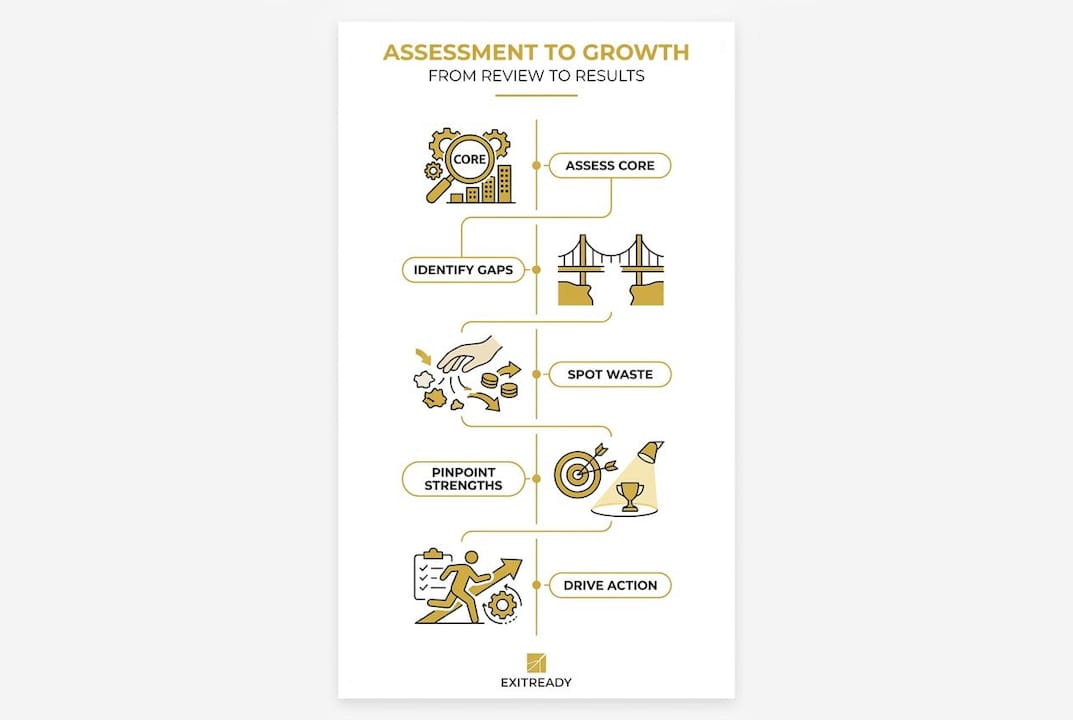
Here is how a structured assessment surfaces these growth opportunities:
- Workflow mapping identifies bottlenecks. When you document how work actually flows through the business, not how it is supposed to flow, you find the handoffs where things slow down, get lost, or require owner intervention to move forward.
- Leadership alignment reveals execution gaps. Leadership clarity drives team roles and expectations, which is the primary driver of growth. When your leadership team is not aligned on priorities, your people receive mixed signals and default to inaction or workarounds.
- Data analysis pinpoints cost inefficiencies. Comparing operational data against industry benchmarks surfaces underperforming areas that are often invisible when you are managing from inside the business.
- Technology audits reveal tool sprawl. Most mid-market companies are running more software platforms than they need, with overlapping functions and no clear data ownership. This slows decision-making and creates reporting blind spots.
Modern growth audits have also become significantly more efficient. Major growth audits now combine manual workflow documentation with AI analysis tools, compressing assessments that once took weeks into a fraction of the time. For owners who have avoided assessments because of the perceived disruption, that shift changes the calculation considerably.
Beyond operational waste, assessments also confirm what is working. Knowing your genuine competitive advantages, documented and validated through data, allows you to allocate capital and attention toward the things that actually move the needle for your growth targets.
Timing and frequency: making assessments a continuous discipline
One of the most common mistakes mid-market owners make is treating assessments as a one-time project triggered by a crisis. That reactive model means you are always diagnosing problems that are already costing you money.

Leading organizations conduct comprehensive assessments every 2-3 years, synchronized with strategic planning cycles, and supplement those with quarterly pulse checks. This creates a discipline of continuous improvement rather than sporadic course corrections.
Specific trigger events that should prompt an assessment outside the normal cycle include:
- A key leadership departure or new executive hire
- Revenue growth that has plateaued for two or more consecutive quarters
- Plans to acquire another company or enter a new market
- Preparation for a funding round, sale, or ownership transition
- A significant shift in the competitive environment or customer behavior
Quarterly pulse checks do not require the full scope of a comprehensive review. They focus on three to five priority metrics identified in the last full assessment, checking whether the corrective actions taken are producing the expected results. This keeps the organization accountable without creating assessment fatigue.
Pro Tip: Tie your quarterly pulse check to a standing leadership meeting agenda item. Assessments that live inside existing rhythms get done. Assessments that require scheduling separate dedicated sessions get postponed.
A year-end comprehensive assessment is particularly valuable for aligning financial accuracy, compliance readiness, and strategic priorities before the new planning cycle begins. Think of it as resetting your baseline before committing resources to next year’s growth targets.
Practical steps for turning assessments into growth plans
Knowing that assessments matter is one thing. Building the internal discipline to run them effectively and act on what they reveal is a different skill set entirely.
Here is a practical sequence for business owners who are ready to treat assessments as a growth driver rather than a paperwork exercise:
- Prepare your data before you start. Pull together financial statements, operational metrics, customer feedback data, and any existing process documentation. Gaps in this data set are themselves a finding worth noting.
- Engage your leadership team early. An assessment that only reflects the owner’s perspective misses critical ground-level intelligence. Your leadership team sees operational reality that you do not.
- Use an external facilitator for objectivity. Internal assessments are prone to confirmation bias. An experienced external partner surfaces uncomfortable findings that internal teams tend to soften or rationalize away.
- Convert findings into a prioritized action plan. Effective assessments produce prioritized roadmaps with clear ownership, timelines, and measurable success criteria. A report that sits in a folder is not an assessment. It is an expense.
- Integrate actions into your management system. Assessment follow-through lives or dies in your regular management cadence. If the priorities from the assessment are not tracked in the same system your team uses for daily accountability, they will fade within 90 days.
Pro Tip: Rank every finding from your assessment by two variables: revenue impact and implementation effort. Start with high-impact, low-effort items to build momentum and demonstrate ROI before tackling the harder structural changes.
The table below illustrates how to prioritize common assessment findings for maximum growth impact:
| Finding category | Revenue impact | Implementation effort | Priority level |
|---|---|---|---|
| Undocumented core processes | High | Medium | Start first |
| Leadership alignment gaps | High | High | Plan for 90-day sprint |
| Outdated technology tools | Medium | Medium | Second phase |
| Compliance and risk gaps | Variable | Low to medium | Immediate if urgent |
| Pricing and margin analysis | High | Low | Start first |
Measuring the impact: what good assessments actually improve
The skepticism around business assessments often comes from owners who have done them before and seen no material change in business performance. That outcome is almost always a follow-through problem, not an assessment problem.
When assessments are executed well and acted on consistently, the measurable improvements are significant:
- Profitability: Eliminating operational waste and improving pricing strategy directly expands margins. Updated valuations and financial assessments prevent the kind of capital misallocation that quietly erodes profit year over year.
- Revenue growth: Identifying your highest-performing customer segments and most profitable service lines allows you to concentrate resources where returns are highest. Customer feedback integrated into assessments can add 20 to 40 percent to revenue growth by surfacing unmet demand.
- Operational efficiency: Documented, repeatable processes reduce owner involvement in daily decisions. That frees your time for the work that actually builds enterprise value.
- Employee engagement: Alignment created through assessments strengthens leadership clarity on roles and expectations, which directly improves team performance and retention.
“Business assessments are strategic health checks designed to uncover improvement opportunities that save time, reduce stress, and create space for real growth.”
The metric that matters most to Dynamicgrowthsolutions clients is owner dependency. When assessments are used to identify and then systematically remove the processes that require the owner’s personal involvement, the business becomes both more scalable and more valuable. A company that runs without you is worth significantly more than one that stalls the moment you step back. That is the true business evaluation for success that mid-market owners should be tracking.
My take on why most owners underuse their best diagnostic tool
I have worked with enough mid-market businesses to know the pattern. The owner runs a strong operation, generates solid revenue, and is genuinely talented at the core service or product. But when I ask when they last did a comprehensive business assessment, the answer is usually “when we had to” or “a couple of years ago, I think.”
The problem is not laziness. It is that assessments feel backward-looking to growth-oriented owners. You want to be building, not reviewing. What I have found, though, is that the owners who grow fastest are the ones who build assessment discipline into their forward motion, not away from it. They know exactly where their business is strong, where it is fragile, and where capital invested today will produce the most return in 18 months.
What I have also seen consistently is that assessments without leadership commitment are theater. You can hire the best consultants, produce a beautiful report, and then watch it gather dust because no one in the organization has the authority or accountability to act on it. The assessment itself is not the work. The follow-through is the work. And that requires an owner who is willing to hear uncomfortable findings and treat them as growth data rather than criticism.
The mid-market businesses that scale well, reduce owner dependency, and position themselves for a premium exit are the ones who stop working in the business and start working on it. Assessments are the mechanism that makes that shift possible. Without them, you are navigating by feel in a business that is too complex to manage on instinct alone.
— Andre
Start using assessments to build a business that scales without you

If you recognize the patterns described in this article, including owner dependency, undocumented processes, or growth that has stalled despite strong effort, a structured assessment is where the work begins. Dynamicgrowthsolutions helps mid-market owners run assessments that do not just produce findings but convert directly into prioritized execution plans tied to real business metrics.
The AOS (Accelerated Operating System) integrates assessment insights into a business management system built for continuous improvement, not one-time reviews. From identifying your highest-leverage growth levers to building the documented playbooks that reduce your personal involvement, every step is designed to make your business more scalable and more valuable. Whether your goal is operational independence, a premium exit, or accelerated growth, the process starts with knowing exactly where you stand. Explore how Dynamicgrowthsolutions can guide your business exit planning and strategic assessment work.
FAQ
What is the role of business assessments in growth?
Business assessments function as diagnostic tools that reveal operational inefficiencies, leadership gaps, and strategic misalignments that limit growth. Addressing these findings through prioritized action plans directly improves profitability, efficiency, and scalability.
How often should a mid-market business conduct assessments?
Comprehensive assessments every 2-3 years aligned with strategic planning cycles, supplemented by quarterly pulse checks, give mid-market businesses the continuous visibility needed to stay ahead of growth blockers.
Can assessments actually reduce owner dependency?
Yes. Assessments identify the specific processes and decisions that require owner involvement, which is the first step toward documenting and delegating them. Reducing owner dependency increases both operational capacity and business valuation.
What metrics improve most after a business assessment?
The metrics most consistently improved include profit margins, operational efficiency, employee engagement, and revenue concentration. Financial assessments also prevent the capital misallocation that quietly erodes growth over time.
What is the biggest mistake owners make with assessments?
Failing to convert findings into an accountable action plan with clear ownership and timelines. An assessment that produces a report but no follow-through process adds cost without adding value.