
You built a successful company, and somehow that success became the trap. Your calendar is full of approvals, escalations, and decisions only you can make, and the strategic work that would actually grow the business sits untouched on a whiteboard. This is the defining tension of mid-market ownership: the harder you work in your business, the harder it becomes to work on it. The goal of this guide is to change that. You’ll learn how to diagnose the problem, audit your time, build systems that hold without you, and ultimately prepare your business for the kind of operational independence that commands a premium exit.
Thank you for reading this post, don't forget to subscribe!Table of Contents
- Recognizing the problem: are you working in or on your business?
- Preparing to work on your business: auditing tasks and setting priorities
- Execution phase: building systems and strategic delegation frameworks
- Verifying progress: testing business independence and operational resilience
- Why true leadership means working on the business, not just in it
- Ready to build a business that works without you?
- Frequently asked questions
Key Takeaways
| Point | Details |
|---|---|
| Time audit reveals reality | Logging all your tasks shows that most work can be delegated or automated, leaving only about 20% as founder-only tasks. |
| Delegate with authority | Effective delegation involves granting decision rights and clear escalation paths, not just task assignment. |
| Build operator-independent systems | Documented processes and leadership structures increase business value and reduce founder dependency. |
| Test independence regularly | A two-week founder absence test validates if systems function properly without owner involvement. |
| Strategic work drives growth | Allocating dedicated time for working on your business enables better decisions and scaling opportunities. |
Recognizing the problem: are you working in or on your business?
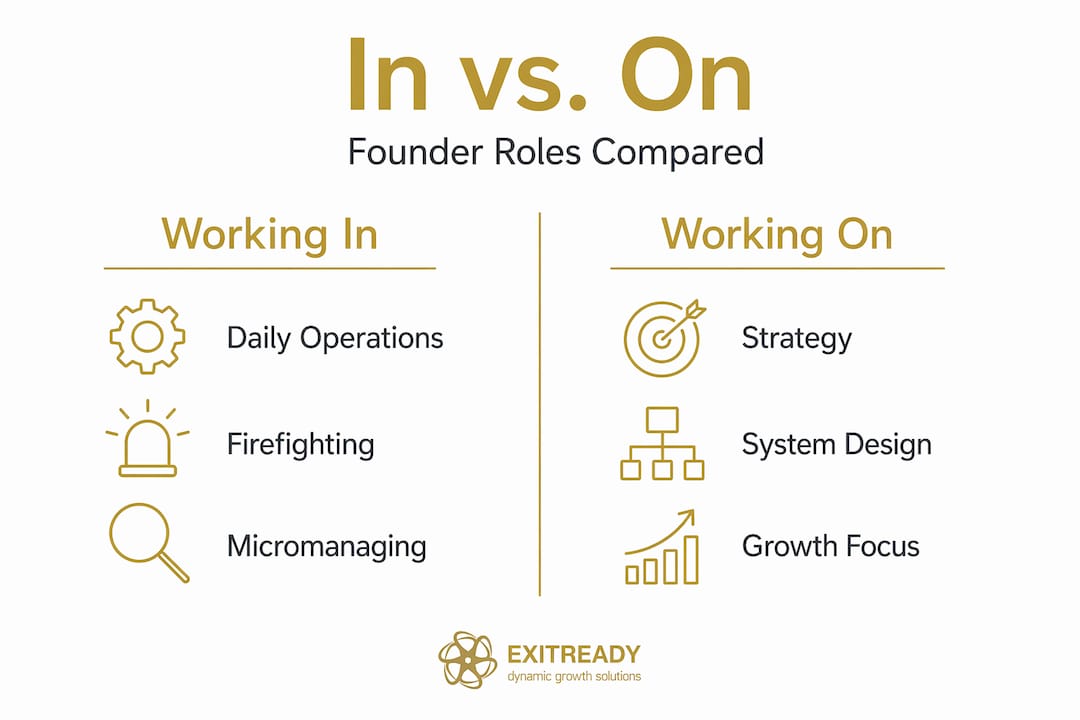
The distinction between working in your business and working on it sounds simple. In practice, most owners can’t tell the difference because both feel like “work.”
Working in the business means handling the urgent and operational: answering client calls, reviewing every proposal, fixing team conflicts, and approving invoices. These tasks keep the lights on. Working on the business means something entirely different. It’s building the systems, leadership capacity, and market positioning that determine where your company is in three years. It’s the work that makes everything else easier, and it’s the work most owners never get to.
The signs you’re stuck in operational mode are worth naming clearly:
- You are the last stop for decisions your managers should own
- Vacations create backlogs, not smooth handoffs
- You know your revenue number but not your CEO performance metrics
- Your team is competent but waits for your signal before acting
- Strategic planning sessions keep getting pushed to “next quarter”
“Successful but trapped owners should aim for at least 15 hours a week of uninterrupted strategic creation time.”
That number, 15 hours, is a useful benchmark. Most mid-market owners aren’t close to it. They’re spending those hours in status meetings and approval queues instead. The other overlooked symptom is underinvestment in team leadership development. When you don’t have time to develop your managers, they don’t develop the judgment to act without you, and the cycle continues.
Preparing to work on your business: auditing tasks and setting priorities
Now that you understand your current time usage, the next step is to prepare your business by breaking down tasks for delegation and automation.
Start with a founder time audit. For one full week, log every task and decision you touch, how long it took, and whether it required your unique expertise. Be honest. Most founders are surprised to find that only about 20% of their time goes to work that genuinely requires their involvement. The rest is trainable, automatable, or simply eliminable.
Once you have your log, sort every task into four categories:
- Founder-only: Strategic decisions, key relationships, culture-setting, capital allocation
- Trainable: Tasks a capable manager could own with proper documentation and context
- Automatable: Repetitive, rule-based work that a tool or workflow can handle
- Eliminable: Meetings, reports, and approvals that exist out of habit, not necessity
After categorizing, prioritize documenting your trainable tasks first. These are your fastest wins. A well-written standard operating procedure (SOP) for a recurring process can remove you from that loop permanently within weeks.
Here’s a practical framework for categorizing your weekly time:
| Task category | % of typical founder time | Priority action |
|---|---|---|
| Founder-only | 20% | Protect and expand this time |
| Trainable | 45% | Document and delegate |
| Automatable | 25% | Identify tools and build workflows |
| Eliminable | 10% | Cut immediately |
Pro Tip: Use workflow optimization methods to identify where process gaps are creating unnecessary founder involvement before you start delegating. Fixing a broken process before handing it off saves you from delegating chaos.
Once you’ve completed the audit, start blocking a minimum of 15 hours per week for strategic work. Treat it like a board meeting. It doesn’t move. This is the foundation of your operating model framework, and it’s where the real transformation begins. If you want a structured way to track whether you’re actually spending time on the right priorities, tracking CEO KPIs gives you a concrete set of measures to hold yourself accountable.
Execution phase: building systems and strategic delegation frameworks
With your tasks categorized and priorities set, it’s time to build the systems and delegation structures enabling you to step back from daily work.

The most common mistake owners make here is writing SOPs for experts. They document what they do, not how someone learns to do it. Your SOPs need to be written for the least experienced person who will ever perform that task. Use platforms like Notion or Trainual where documents are searchable, updatable, and connected to real workflows. A document no one can find is the same as no document at all.
Building your delegation structure:
- Map every recurring decision to a role using a RACI matrix. RACI stands for Responsible, Accountable, Consulted, and Informed. It eliminates the ambiguity that forces decisions back to you.
- Apply graduated delegation for high-stakes tasks. Don’t hand over a complex client relationship on day one. Start with observation, move to supervised execution, then full ownership over 60 to 90 days.
- Use the 80% rule consistently: if someone can execute a task at 80% of your quality level, delegate it with clear intent and let them own the outcome. Perfection at the cost of your strategic time is a bad trade.
- Automate before you delegate where possible. Scheduling, invoicing, client onboarding reminders, and contract renewals are all candidates for business process automation that removes the task from everyone’s plate.
Here’s how owner-dependent operations compare to system-driven ones:
| Dimension | Owner-dependent | System-driven |
|---|---|---|
| Decision-making | Waits for founder approval | Defined in RACI, executed by team |
| Onboarding | Ad hoc, founder-led | Documented, repeatable process |
| Client escalations | Routed to owner by default | Handled by trained managers |
| Exit valuation | Discounted for key-person risk | Higher exit multiples for transferable systems |
| Owner’s weekly hours in ops | 40+ hours | Under 10 hours |
Pro Tip: Before delegating any task, record yourself doing it once on video. It’s faster than writing an SOP from scratch, and your team can reference it while the written version is being built. Tools like Loom make this a five-minute investment per process.
The profit driver case studies from businesses that have gone through this process show a consistent pattern: the owners who build the most valuable companies are not the ones who work the hardest. They’re the ones who build the best systems. The operating model inflection point, where the business stops needing the founder for daily operations, is where enterprise value accelerates.
Verifying progress: testing business independence and operational resilience
Once your delegation and systems are in place, confirming they work during your absence is critical to ensure lasting freedom and business value.
The most direct test is a two-week founder absence test. Step away completely. No Slack, no email, no “just checking in” calls. Let your team run the business. What breaks reveals exactly where your systems are still immature. Building independence typically takes 18 to 24 months, and the two-week test is the clearest signal of where you are in that journey.
To measure your progress quantitatively, track “days until the business breaks” as a metric. On day one of your absence, how long does it take before a decision escalates to you? That number should grow with each iteration of your systems.
Here’s the operating cadence that keeps your team aligned without you in every meeting:
- 90-day goals: Set clear, measurable objectives each quarter that your leadership team owns
- 30-day sprint plans: Break quarterly goals into monthly priorities with assigned owners and success metrics
- Weekly leadership standups: 30 to 45 minutes, structured around blockers and decisions, not status updates
This synchronized execution approach via 90-day objectives, 30-day sprints, and weekly standups measurably boosts alignment and decision quality across leadership teams.
Beyond the cadence, maintain these supporting tools:
- Decision logs: A shared record of significant decisions made, by whom, and why. This builds institutional memory and reduces repeated debates.
- Risk registers: A living document of known risks, their likelihood, and who owns mitigation. This keeps your team proactive rather than reactive.
- RACI updates: Revisit your RACI quarterly. As the business evolves, so do roles and decision rights.
When you review your exit readiness metrics, operational independence is one of the highest-weighted factors. Buyers don’t just buy revenue. They buy confidence that the revenue continues after you leave.
Why true leadership means working on the business, not just in it
Here’s the uncomfortable truth most business owners don’t want to hear: the reason you’re still buried in operations isn’t a time management problem. It’s an identity problem.
Many mid-market owners built their companies by being the best operator in the room. That skill got them to $10 million or $50 million in revenue. But the same instinct that made them great operators makes them poor strategic leaders. They confuse activity for progress. They mistake busyness for value creation. And deep down, many of them don’t fully trust their teams, not because the teams aren’t capable, but because they’ve never been given real authority to prove it.
Working on the business means improving the conditions for performance through strategic thinking. It’s the essential leadership work that builds future capacity. That framing matters because it repositions strategic work from a luxury to a responsibility. You’re not stepping back because you’re lazy. You’re stepping up because your company needs a leader, not another operator.
The owners who make this shift successfully share one habit: they build trusted teams and then actually trust them. They give decision authority, accept the occasional 80% outcome, and use the time they reclaim to do the work only they can do. Visioning. Market positioning. Capital strategy. Culture. The work that doesn’t show up in a weekly standup but determines whether your business is worth $10 million or $40 million in five years.
Strategic delegation isn’t just about reducing your workload. It’s about building a company that has value independent of you. That’s the real goal. And it’s the kind of leadership strategy that separates owners who exit well from those who can’t exit at all.
Ready to build a business that works without you?
You now have the framework. The audit, the systems, the delegation structure, the independence tests. The question is whether you build it alone or with a team that has done it hundreds of times before.
Dynamic Growth Solutions’ EXITREADY program is built specifically for mid-market owners who are ready to stop being the bottleneck and start building a business that runs, grows, and exits on their terms. From documenting your first SOPs to building a full leadership layer, the AOS entrepreneur application starts with a diagnostic that shows exactly where your business stands today. If you want to understand the operating model inflection framework and how it applies to your specific situation, or if you’re wondering why most businesses never sell and how to make sure yours does, this is the next step. Expert guidance doesn’t just accelerate the process. It ensures you don’t spend 18 months building systems that don’t hold.
Frequently asked questions
What does it mean to work on your business rather than in it?
Working on your business means focusing on future strategy and building systems that allow the business to operate independently, rather than handling daily operational tasks yourself.
How long does it take to make a business operate without the founder?
Achieving operational independence typically takes 18 to 24 months, including documentation, delegation, and validation through founder absence tests.
What is a founder time audit and why is it important?
A founder time audit logs every task over one week to reveal that only about 20% of founder time requires genuine founder involvement, making it the essential first step in effective delegation.
How can delegation improve a business’s exit value?
Operator-independent systems command higher exit multiples because buyers pay a premium for businesses that don’t depend on the founder to function.
What tools help automate business processes effectively?
Tools like Calendly for scheduling, FreshBooks or Zoho for invoicing, and Zapier for connecting workflows automate repetitive tasks so founders and their teams can focus on higher-value work.