
Many business owners treat certification as a status symbol, something to display on a website or pitch deck. But that framing misses the real story. Certification, when done right, is a rigorous third-party process that forces you to build documented systems, prove operational discipline, and meet standards that buyers, agencies, and partners actually care about. For mid-market owners thinking about growth, succession, or a strategic exit, understanding what certification truly demands, and what it truly delivers, can change the trajectory of your business.
Thank you for reading this post, don't forget to subscribe!Table of Contents
- What business certification really means
- Types of business certification and why owners pursue them
- How the business certification process works
- How certification drives operational discipline and owner-independence
- Avoiding common pitfalls: Owner decision rules for certification
- What most owners miss about business certification
- Building a certificate-worthy, exit-ready business
- Frequently asked questions
Key Takeaways
| Point | Details |
|---|---|
| Third-party validation | Certification shows an outside organization has verified your business meets important standards. |
| Strategic benefits | Certification can open doors to new contracts, funding, and credibility in the market. |
| Operational discipline | Preparing for certification helps document systems and reduces owner dependency. |
| Exit readiness | A certified, systematized business is more attractive and valuable to buyers. |
| Quality over quantity | Focus on certifications that drive real business improvements, not just credentials. |
What business certification really means
Let’s clear something up first. A business certification is not the same as registering your LLC, getting a business license, or slapping a badge on your website. Those actions are self-directed. Certification is something different entirely.
As the NMSDC certification process makes clear, “business certification” generally means a third party verifies that a business meets defined standards or eligibility requirements. You don’t certify yourself. An external body reviews your evidence, your documentation, and sometimes your operations directly, then decides whether you qualify.
There are two main categories worth knowing:
- Standards-based certifications: These verify that your business operates according to a defined quality or management standard. ISO 9001 is the classic example. It tells the world your quality management system meets an internationally recognized benchmark.
- Eligibility or participation certifications: These verify that your business qualifies for a specific program or opportunity. Think SBA 8(a), minority-owned business certification, woman-owned small business (WOSB), or veteran-owned status. These open doors to government contracts, supplier diversity programs, and procurement pipelines.
“Certification is not a claim you make about yourself. It is a conclusion an independent body reaches about you after reviewing your evidence.”
Who issues these credentials? It depends on the type. Government agencies like the Small Business Administration issue eligibility certifications. Industry bodies like ISO-accredited registrars handle standards certifications. Private organizations like the National Minority Supplier Development Council (NMSDC) manage supplier diversity credentials. Understanding who issues what matters because it determines how rigorous the process is and how much weight the credential carries.
A common misconception is that certification is just a marketing move. It isn’t. Sophisticated buyers, procurement officers, and strategic partners use certifications as a proxy for operational trust. If you want to understand certification’s role in exit readiness, the connection runs deeper than most owners realize. The credential signals that your business can be evaluated, verified, and trusted by people who have never met you. That is enormously valuable in a transaction or a contract negotiation.
For a broader look at what options exist, the certification types explained guide from the U.S. Chamber of Commerce is a solid starting point.
Types of business certification and why owners pursue them
Defining certification sets the stage. Now let’s explore what options exist and why owners like you should care about choosing the right one.
There are two broad tracks: government and supplier diversity certifications, and standards or quality certifications. Each serves a different strategic purpose.
| Certification | Issuing Body | Primary Benefit | Who It’s For |
|---|---|---|---|
| SBA 8(a) | U.S. Small Business Administration | Access to federal sole-source contracts | Socially/economically disadvantaged businesses |
| ISO 9001 | ISO-accredited registrar | Quality management credibility | Manufacturing, services, B2B suppliers |
| WOSB/EDWOSB | SBA | Federal contracting set-asides | Women-owned small businesses |
| NMSDC MBE | NMSDC | Corporate supplier diversity access | Minority-owned businesses |
| WBENC | WBENC | Corporate supplier diversity access | Women-owned businesses |
In the U.S., a common business certification category is small-business certification for government contracting and market access, where eligibility and type depend on criteria like size, ownership, and status, such as 8(a). This means not every certification is available to every business. Your size, revenue, ownership structure, and industry all factor in.
Here is why the right certification improves your positioning for growth and eventual sale:
- Credibility with buyers and procurement officers who use certification as a shortcut to trust.
- Access to contracts and programs that are set aside exclusively for certified businesses.
- Network access through certification bodies that connect you with corporate buyers and government agencies.
- Operational benchmarking that forces you to measure and document how your business actually runs.
- Higher perceived enterprise value because documented, verifiable systems are more transferable than founder-dependent operations.
The why systems matter argument from Kaizen ISO Consulting is compelling: quality certifications don’t just win contracts, they build the operational backbone that makes a business worth buying.
Pro Tip: Don’t chase labels. Seek certifications that align with your operational maturity and the expectations of your most important buyers or strategic partners. A certification that requires no real change to how you operate will not move the needle on enterprise value.
When you think about exit planning considerations, the certifications that matter most to buyers are the ones that prove your business can run without you. That’s a much higher bar than most owners expect.
How the business certification process works
Understanding the types and motives, let’s get specific about how certification processes operate and what is expected of you.
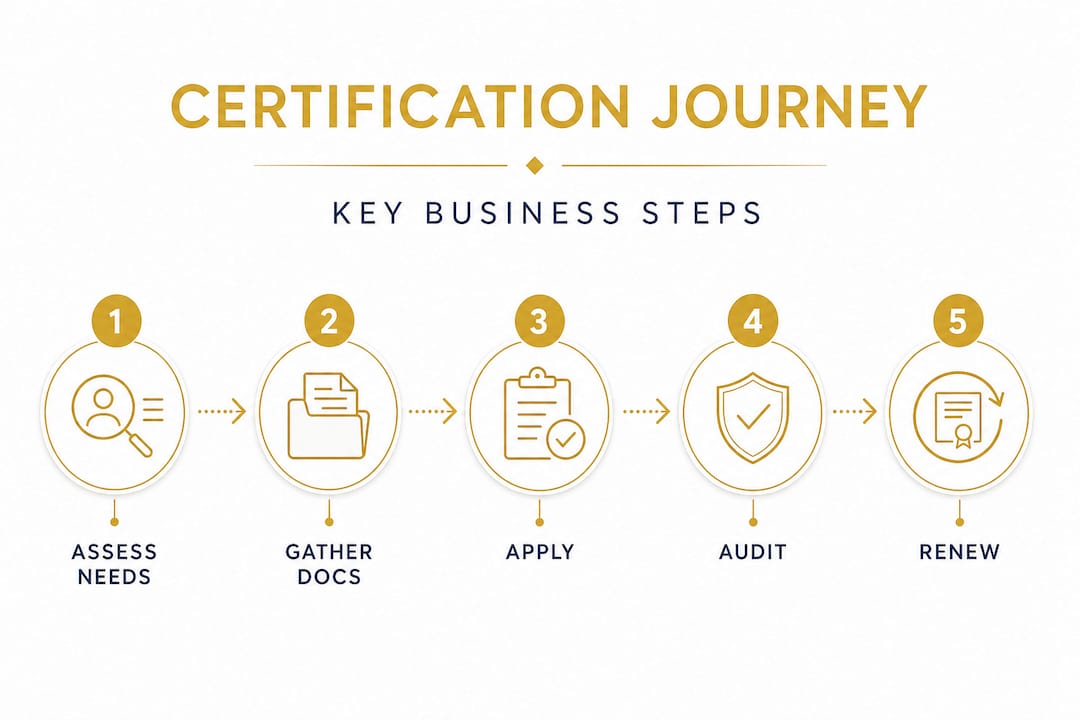
The mechanics vary a lot by certification type, but many programs share a common workflow: determine eligibility, gather documentation, undergo review (sometimes including a site visit or interview), and be issued certification if requirements are met.
Here is what that looks like in practice:
- Eligibility check: Before you invest time in paperwork, confirm you meet the basic criteria. For 8(a), that means demonstrating social and economic disadvantage. For ISO 9001, that means having a quality management system in place or being ready to build one.
- Documentation gathering: This is where most businesses struggle. You need to produce evidence, not just assertions. Ownership records, financial statements, organizational charts, process manuals, and quality records are all common requirements.
- Application submission: Each certification body has its own portal or process. Errors and omissions at this stage cause delays.
- Review and verification: This may involve a desk review, follow-up questions, or an in-person or virtual site visit. Some programs conduct interviews with owners and key staff.
- Credential issued (or denied): If you pass, you receive the certification. If not, you typically receive feedback and can reapply.
| Document Type | Standards Certification (e.g., ISO 9001) | Eligibility Certification (e.g., 8(a), MBE) |
|---|---|---|
| Ownership records | Not required | Required (critical) |
| Financial statements | Sometimes required | Required |
| Process documentation | Required (core) | Sometimes required |
| Organizational chart | Sometimes required | Required |
| Quality manuals/SOPs | Required (core) | Not typically required |
| Site visit | Common | Common for larger programs |
Pro Tip: Sloppy or inconsistent documentation can tank your application or, worse, get your certification revoked after the fact. Treat the documentation process as a systems audit of your own business. What you find will tell you a lot about where your operational gaps are.
Certification is also not a one-time event. Most credentials require annual renewals, periodic audits, or updated filings. If your business changes significantly, such as a change in ownership or a major shift in operations, you may need to notify the certifying body or reapply. For more on detailed process documentation, our blog covers the operational side in depth.
You can also get a practical overview of starting your certification from Bank of America’s small business resource center.
How certification drives operational discipline and owner-independence
Knowing the process, let’s dig deeper on why the journey of getting certified is, in itself, transformational, especially for owners thinking about succession or sale.

Here is the insight most owners miss: the credential is visible, but as Kaizen ISO Consulting points out, the value comes from the underlying practices and documentation certifications force you to build. The certificate on your wall is the byproduct. The documented, repeatable systems you built to earn it are the real asset.
Think about what buyers actually want when they evaluate a business for acquisition. They want to know the business will keep running after you leave. That means they need to see:
- Written standard operating procedures (SOPs) that any capable employee can follow
- Documented roles and responsibilities that do not depend on tribal knowledge
- Measurable quality or performance standards with evidence of consistent results
- A management structure that does not collapse when the founder steps out
- Financial records that are clean, accurate, and independently verifiable
Getting certified forces you to build exactly these things. Here is how:
- ISO 9001 requires you to document your quality management processes, define roles, set measurable objectives, and conduct internal audits. That is a buyer-ready operations manual in disguise.
- NMSDC MBE or WBENC certification requires you to prove ownership structure clearly, which forces clean corporate governance documentation.
- SBA 8(a) requires detailed financial records and business plans, which forces financial discipline.
“The system behind the certificate helps win repeat business. The discipline you build to earn it is what makes your company worth buying.”
The overlap between certification work and exit due diligence is significant. When a buyer’s team conducts due diligence, they are essentially running a certification review of your business. If you have already been through a rigorous certification process, you are dramatically better prepared.
For owners thinking about transferability and systems maturity, the certification journey is one of the most practical forcing functions available. It gives you an external deadline and an external standard to meet, which is far more motivating than an internal initiative that keeps getting pushed back. Understanding how buyers assess readiness can sharpen your focus on what actually matters during this process.
Avoiding common pitfalls: Owner decision rules for certification
By seeing the upside of operational discipline, it’s essential to close with rules of thumb that help you choose or avoid certifications wisely.
First, the cautionary note. Certifications with weak or incomplete documentation can be revoked. When that happens, the credibility damage is real. A revoked certification signals to buyers and partners that your business either misrepresented itself or failed to maintain standards. That is worse than never having pursued it.
Before committing to any certification, examine these four factors:
- Cost: What are the application fees, renewal fees, and the internal staff time required? Some certifications cost thousands of dollars annually plus significant internal labor.
- Ongoing requirements: What does maintenance look like? Annual audits, document updates, and compliance reporting are common. If you cannot sustain the requirements, do not start.
- Internal effort: How much operational change is required? If the answer is “none,” that certification probably will not add enterprise value either.
- Buyer impact: Will your target buyers, whether corporate procurement teams, government agencies, or acquisition buyers, actually recognize and value this credential?
The Scott Sylvan Bell SCORE framework offers a useful lens here: prioritize certifications whose requirements force you to build systems maturity and operational discipline rather than chasing credentials.
Pro Tip: Use certification as a forcing function to build the systems buyers want. Every shortcut you skip, every process you actually document, and every standard you genuinely meet adds to your enterprise value. The credential is the reward. The systems are the prize.
Lessons from owner exits consistently show that businesses with documented, verifiable operations command better multiples and close faster. Certification is one of the most structured paths to getting there.
What most owners miss about business certification
Here is the hard truth most certification articles will not say out loud: the credential itself rarely impresses sophisticated buyers. What impresses them is the evidence of discipline, rigor, and operational independence that sits underneath it.
We have seen owners pursue certifications that required nothing more than a fee, a logo, and a self-attestation form. Those certifications did not raise their exit value by a single dollar. They were marketing badges, not operational achievements. Sophisticated buyers see through them immediately.
The certifications that actually move the needle are the ones that required you to change something. The ones that forced you to write down how your business works, define who is responsible for what, and prove that your results are consistent and measurable. Those are the certifications that overlap with what certification and transferability really mean in an exit context.
The contrarian view is this: you do not need a certification to build a buyer-ready business. But if you are going to pursue one, choose it specifically because the process will force you to build systems you should have built anyway. Use the certification deadline as your accountability mechanism. Use the certification standards as your blueprint. And use the credential as proof of work, not a substitute for it.
The lessons from the field are consistent: owners who treated certification as a systems-building exercise came out ahead. Owners who treated it as a marketing exercise came out with a logo and not much else.
True certification value lives in documented, repeatable, independent systems. The sticker is just the receipt.
Building a certificate-worthy, exit-ready business
You now understand what certification really demands and what it can genuinely deliver. The next step is making sure your business is built to meet those standards, not just on paper, but operationally.
At Dynamic Growth Solutions, our AOS (Accelerated Operating System) is designed specifically to help mid-market owners build the documented systems, operational independence, and strategic clarity that certification processes reward and that buyers require. Whether you are preparing for a supplier diversity certification, an ISO audit, or a full business sale, the foundation is the same: repeatable processes, clear accountability, and measurable results. If you want to understand why most businesses fail to sell before you make that mistake, start there. Then explore our operational improvement tools and take the first step by submitting your AOS entrepreneur application to see where your business stands today.
Frequently asked questions
What is the main difference between a business certification and a business license?
A business certification is a third-party verification that a business meets defined standards or eligibility requirements, while a license is government permission to legally operate in a given location or industry.
What types of businesses benefit most from certification?
Small businesses seeking government contracts, supplier diversity programs, or improved operational discipline gain the most, as certification increases credibility and access to opportunities that are otherwise closed off.
How long does it take to become certified?
The timeline varies widely, but many programs involve multiple steps including document review and possible interviews, meaning the process typically ranges from a few weeks to several months depending on documentation readiness.
What happens if a business cannot provide the required documentation for certification?
If documentation is thin or inconsistent, certification can be denied outright or revoked after the fact, which can damage credibility with buyers, partners, and procurement agencies.