
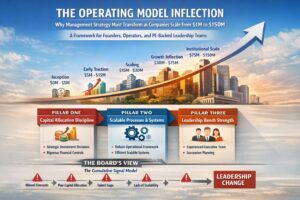
THE OPERATING MODEL INFLECTION
Why Management Strategy Must Transform as Companies Scale from $1M to $150M
A Framework for Founders, Operators, and PE-Backed Leadership Teams
CEO replacement in PE environments rarely comes from a single event — it’s the cumulative signal that the operating model hasn’t caught up with the investment thesis.
Most conversations about leadership transitions focus on the wrong variable. They fixate on the individual — their style, their temperament, their ability to “scale.” But in private equity environments, where time horizons are compressed and value creation is explicit, boards are watching something else entirely: whether the operating model has kept pace with the growth trajectory.
The $1M to $150M journey is not a single arc. It is a series of distinct phases, each demanding a fundamentally different management architecture. What makes a founder exceptional at $5M — speed, instinct, personal accountability — can become the exact liability that limits the company at $50M. What works at $50M may quietly fracture under the complexity of $150M. The transitions are rarely dramatic. They accumulate.
This article maps those transitions: the structural shifts in how companies must be led, the capital allocation disciplines that separate scalable businesses from ones that plateau, and the board-level signals that precede leadership change — often months before the numbers fully reflect it.
Part I: The Five Stages of Growth — and What Breaks at Each One
Revenue milestones are a useful shorthand, but the real inflection points are structural. They are moments when the informal systems that got the company here actively prevent it from getting to the next stage.
| Stage | Revenue Range | Core Management Challenge |
| Inception | $0 – $5M | Survival, product-market fit, founder-driven everything |
| Early Traction | $5M – $15M | Repeatability: converting founder instinct into process |
| Scaling | $15M – $30M | Delegation without losing quality; first real leadership hires |
| Growth Inflection | $30M – $75M | Capital allocation discipline; systems that scale independently |
| Institutional Scale | $75M – $150M | Leadership bench depth; complexity absorption; cultural coherence |
Stage 1: $0–$5M — Founder as Organism
At this stage, the company is an extension of the founder. Decision-making is centralised not by design but by necessity. Speed is the primary competitive advantage. Processes are informal or non-existent, and that is largely fine — what matters is survival and iteration.
The management structure is flat not because it is considered optimal, but because there is rarely anyone else. The founder sells, hires, sets product direction, handles key client relationships, and manages the books. The “system” is the founder’s memory and judgment.
What works: Velocity. The ability to pivot without bureaucratic drag. Proximity to the customer. Personal accountability for every outcome.
What it costs: Scalability. Every decision bottlenecks at one person. Institutional knowledge lives nowhere except the founder’s head. Processes don’t exist to be handed off.
Stage 2: $5M–$15M — Converting Instinct into Repeatability
The first genuine management challenge arrives here. Revenue is real. The team has grown to 10–25 people. The founder cannot be everywhere. But the founder’s instincts — which customers to prioritise, which product bets to make, which risks to take — have not yet been codified into anything others can execute independently.
The failure mode at this stage is almost always the same: the founder hires experienced operators but cannot let go. Or conversely, delegates too broadly without adequate process in place, and quality degrades. The first management hires are often peer-level relationships — people the founder trusts personally — rather than functional operators hired against a clear brief.
What boards and investors begin watching here: Is revenue growth creating sustainable unit economics, or is it being bought? Are customer relationships institutionalised or still founder-dependent? Is the founder’s time allocation shifting toward high-leverage activities?
| PE LENS — EARLY TRACTION STAGE
At entry into a $10M–15M business, sponsors are buying the founder’s judgment but betting on their ability to build systems around it. The first red flag is not slow growth — it’s a founder who cannot articulate what is repeatable about the business. |
Stage 3: $15M–$30M — The First Real Leadership Test
This is where the operating model makes its first serious demands. The company now needs genuine functional leaders — a Head of Sales who can build a pipeline without the founder in every meeting, a CFO (or strong VP Finance) who can produce reliable forecasts, an HR function that can run recruiting at scale.
The management challenge shifts from doing to designing. The founder-CEO must become a systems architect: building the processes, incentive structures, and reporting cadences that allow the organisation to execute independently. This is profoundly uncomfortable for founders who built their identity around being the smartest person in the room on any given problem.
The structural changes that matter most at this stage:
- A weekly operating rhythm — structured leadership meetings with clear accountability
- Functional KPIs with ownership, not just top-line revenue tracking
- A hiring bar that prioritises scalable operators over loyal generalists
- Financial visibility: rolling forecasts, not just monthly actuals
The $15M–$30M window is where the largest cohort of PE-backed CEO replacements are seeded — not executed, but seeded. The board begins to see whether the leader can shift identity from operator to architect.
Part II: The $30M–$150M Transformation — The Real Inflection
The transition from $30M to $150M is not a single gear change. It is the period during which three foundational capabilities must be built simultaneously — and the companies that fail to build all three tend to plateau, re-platform, or change leadership before they reach the other side.
Pillar One: Capital Allocation Discipline
Below $30M, capital allocation is largely intuitive. The CEO knows where the money goes because they approve everything. Growth investments are small enough that mistakes are recoverable. The feedback loop between investment and outcome is visible.
Above $30M — particularly in PE-owned businesses with an investment thesis to execute — this informality becomes a structural risk. The company is now large enough that misallocated capital is genuinely value-destructive. Competing priorities (geographic expansion, product investment, sales team scaling, tech infrastructure) can’t all be funded. Choices must be made explicitly.
The discipline required here is not just financial. It is the ability to say no with analytical rigour. To distinguish between investments that compound and those that merely consume. To hold a portfolio view of growth bets rather than funding every initiative that has a credible sponsor internally.
What best-in-class capital allocation looks like at scale:
- A formal annual planning process that translates strategy into resource allocation, not just targets
- A clear framework for evaluating organic versus inorganic growth trade-offs
- Segment-level P&L visibility: knowing which parts of the business are generating returns and which are absorbing subsidy
- A CFO who is a genuine strategic partner, not a scorekeeper
| WHERE BOARDS ACT
Boards in PE environments will tolerate growth that is slower than plan. They are far less tolerant of leaders who cannot explain, with precision, how capital is being deployed and what the return thesis is. The shift from ‘we’re investing in growth’ to granular capital allocation discipline is often the first inflection point where leadership credibility is tested. |
Pillar Two: Scalable Processes and Systems
One of the most common failure modes in the $30M–$75M range is what might be called “heroic operations”: the business works because specific individuals compensate, through personal effort and informal coordination, for the absence of functional systems. Revenue gets booked, customers get served, and products get shipped — but the mechanism is people heroics, not repeatable process.
Heroic operations create three compounding problems as companies scale. First, they are not scalable: you cannot hire enough heroes. Second, they are fragile: when key people leave, capability exits with them. Third, they are opaque: the board and leadership team cannot see where the real constraints are, because the informal system masks them.
The systems investment required to move from $30M to $150M typically spans:
- Sales processes and CRM discipline — pipeline visibility, conversion tracking, forecast accuracy
- Financial systems capable of segment reporting, scenario modelling, and M&A integration
- HR infrastructure: structured onboarding, performance management, compensation benchmarking
- Operational cadences: planning cycles, cross-functional alignment, escalation protocols
The crucial insight is that systems are not an overhead investment. They are an enabler of leadership leverage. A CEO without systems must personally compensate for every gap. A CEO with functioning systems can deploy attention strategically.
The question boards ask is not whether the systems are perfect. It’s whether the leader is building them with urgency — or rationalising their absence.
Pillar Three: A Leadership Bench That Absorbs Complexity
The third pillar is perhaps the most underappreciated, and the one most directly linked to CEO survival in PE environments.
A business at $150M is functionally a different organism from a business at $30M. The complexity of customer relationships, channel mix, team size, regulatory exposure, and competitive dynamics has multiplied. No single individual can hold all of it. The CEO’s job at this scale is not to make every decision but to build the team that makes good decisions consistently.
The leadership bench question has two dimensions:
Capability: Do the functional leaders have the skills to operate at the company’s current and projected scale? A VP of Sales who was excellent at $20M may be genuinely out of depth at $80M — not through any failing of character, but because the job has fundamentally changed.
Capacity: Is the leadership team built for the complexity the business is about to face, not just the complexity it currently holds? PE-backed companies are typically executing against a 3–5 year value creation plan. The bench must be built for that destination, not the current state.
The management architecture shift this demands:
- Deliberate succession thinking: who can step up, what gaps exist, where is the company dependent on one person
- Structured leadership development: not as an HR initiative but as a business risk mitigation
- Willingness to upgrade: the CEO who cannot move on a under-performing direct report is protecting yesterday’s organisation at the cost of tomorrow’s
- A CFO and COO pairing that creates genuine strategic bandwidth for the CEO
Part III: The Board’s View — How Leadership Transitions Are Actually Triggered
In PE environments, CEO transitions are almost never impulsive. They are the product of a thesis that has been forming — often over 12–24 months — that the operating model has fallen structurally behind the investment thesis. By the time a board acts, they have typically accumulated a pattern of signals, not a single event.
The Cumulative Signal Model
Boards are pattern recognition machines. They are watching for the gap between where the business should be operating and where it actually is. Individual misses — a missed quarter, a key hire that doesn’t work out, a system that fails — are rarely decisive. What is decisive is whether those events reveal a systemic lag or are isolated instances.
The signals that accumulate most dangerously:
- Forecast accuracy deteriorates over multiple quarters — not because the market is volatile, but because the internal planning process lacks rigour
- Capital is deployed but the return thesis is unclear or shifting
- The leadership team is not strengthening — the same gaps exist 18 months into ownership that existed at entry
- The CEO’s time allocation remains tactical rather than strategic — still personally compensating for system gaps
- Cultural signals: attrition in high-value roles, internal conflict that doesn’t resolve, a team that can’t execute without the CEO’s involvement
| THE INFLECTION POINT MOST BOARDS WON’T SAY OUT LOUD
Boards don’t replace CEOs because numbers are bad. They replace CEOs when they conclude that the numbers will not get better under the current leadership model — and that waiting longer increases value destruction. The decision is almost always forward-looking, not backward-looking. |
What Boards Actually Want to See
The leaders who navigate the $30M–$150M transition successfully, and retain board confidence through a PE hold period, share a consistent set of behaviours:
- They define the problem before the board names it. They come to quarterly conversations with an honest view of what is not working and a credible plan to address it.
- They build capital allocation fluency. They can tell the story of where money is going and why — and they are willing to cut investments that are not working.
- They upgrade talent before it becomes critical. The best operators are always slightly ahead of the talent requirements of the business.
- They build systems that reduce their own necessity. Counterintuitively, the CEO who makes themselves less operationally indispensable is the one boards trust most.
- They calibrate communication to the board’s actual risk concerns — not just reporting against plan but contextualising what the numbers mean.
Part IV: A Practical Framework for Navigating the Transition
For CEOs and leadership teams navigating this journey — whether founder-led or PE-installed — the following diagnostic questions provide a structured way to assess whether the operating model is keeping pace with scale.
Capital Allocation Audit
- Can you explain, with precision, the top 5 investments you are making and the expected return on each?
- Do you have segment-level economics that allow you to distinguish high-return from low-return activities?
- Is your CFO a strategic counterpart or a financial historian?
- Does your annual plan translate strategy into resource allocation, or does it aggregate bottom-up requests?
Systems and Process Diagnostic
- Which parts of the business run reliably without your direct involvement?
- Where is the business dependent on individual heroics to function?
- What would break if your three most critical operators left in the same month?
- Does your operating cadence — weekly rhythms, monthly reviews, quarterly planning — drive accountability, or is it performative?
Leadership Bench Assessment
- Is your current leadership team built for the company you are in 18 months from now, or the company you are today?
- Which roles have succession coverage? Which are single points of failure?
- Are you moving on underperformance with appropriate speed, or are you protecting relationships at the cost of performance?
- Is your leadership team collectively capable of running the business for a month without you? If not, that is a systems and bench problem, not a workload problem.
The operating model that got you here is not the operating model that will get you there. The question is whether you rebuild it proactively, or whether the board’s timeline forces the issue.
Conclusion: The Proactive Advantage
The companies that navigate the $1M to $150M journey most successfully — and the leaders who survive and thrive through it — share a defining characteristic: they treat the operating model as an active, evolving asset that requires the same strategic investment as the product, the customer base, and the balance sheet.
They understand that leadership transitions in PE environments are not punishments for failure. They are structural responses to a mismatch between the operating model and the investment thesis. And they know that the best way to remain relevant through a scaling journey is to be the person who identifies that mismatch first and builds the answer.
The real inflection point — the one that determines whether leadership change is forced or chosen, reactive or proactive — sits at the intersection of three questions: Are we allocating capital with discipline? Are our systems scaling with the business? And does our leadership bench have the depth to absorb the complexity ahead?
Boards act when the answer to those questions is consistently no. The leaders who ask those questions of themselves, before the board needs to, are the ones who define the next stage of the company’s growth — rather than becoming a footnote in it.
For operators, boards, and investors navigating the $1M–$150M growth corridor.